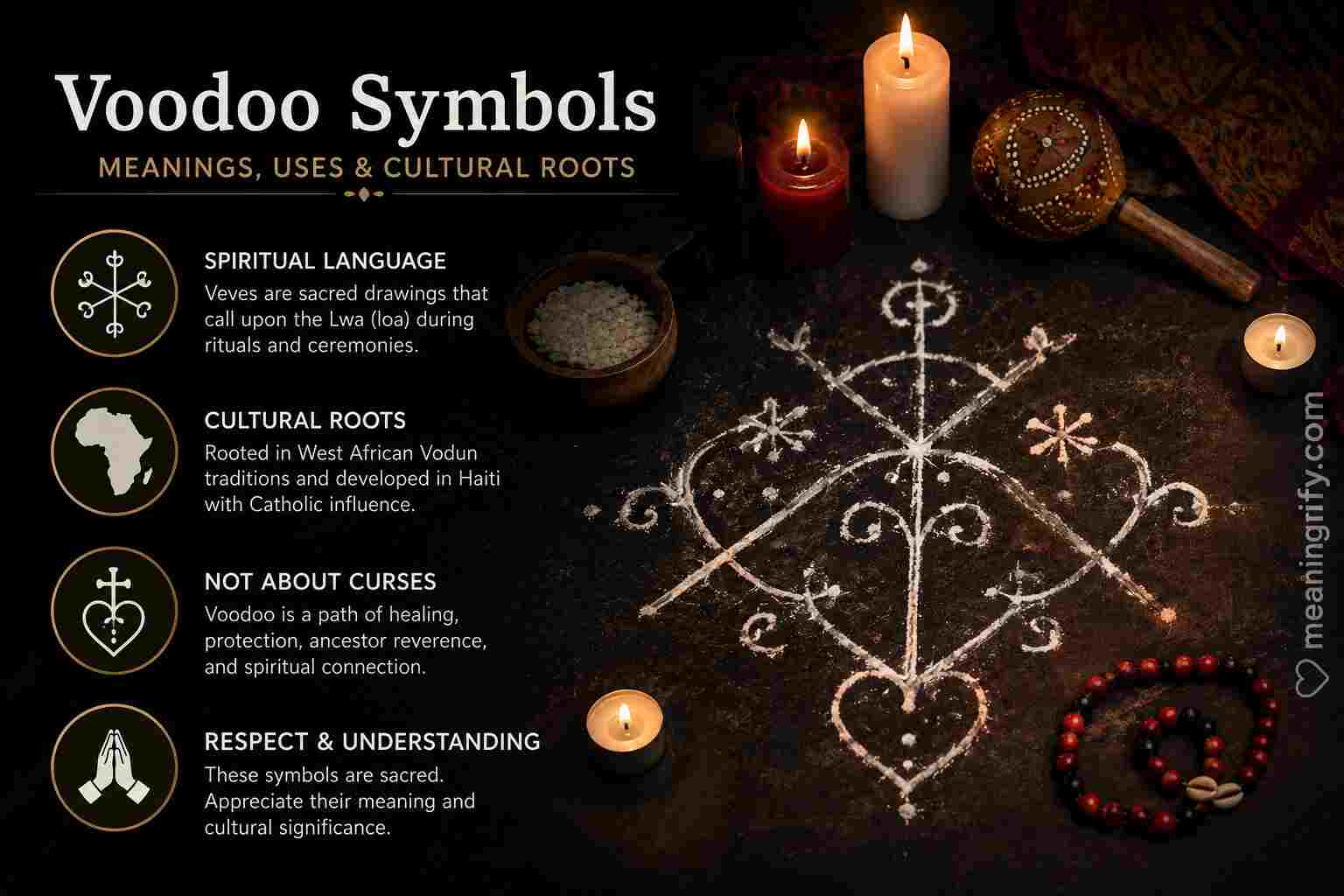
Voodoo symbols have fascinated outsiders and guided practitioners for centuries, yet most of what circulates online is a mix of pop-culture myth and half-truth. The reality is far richer: these symbols, properly called veves, are a living spiritual language tied to Haitian Vodou, West African Vodun, and Louisiana Voodoo. This guide unpacks their real meanings, uses, and cultural roots so you understand the symbolism behind every sign, respectfully and accurately.
What Are Voodoo Symbols?
Voodoo symbols, formally known as veves (also spelled vèvè), are intricate ritual drawings used to invoke specific spirits called Lwa (or loa). Practitioners trace them on the ground using cornmeal, ash, or flour during ceremonies. Each veve acts as a spiritual “beacon,” drawing a particular Lwa into the ceremonial space so devotees can communicate, request guidance, or offer thanks.
The word “voodoo” comes from the Fon word Vodun, meaning spirit or deity. The religion developed in Haiti when enslaved West Africans blended their ancestral beliefs with elements of Catholicism, creating a faith centered on healing, ancestor reverence, and community resilience, not curses or dark magic, despite Hollywood’s portrayal.
Voodoo Symbols | Meanings, Uses and Types
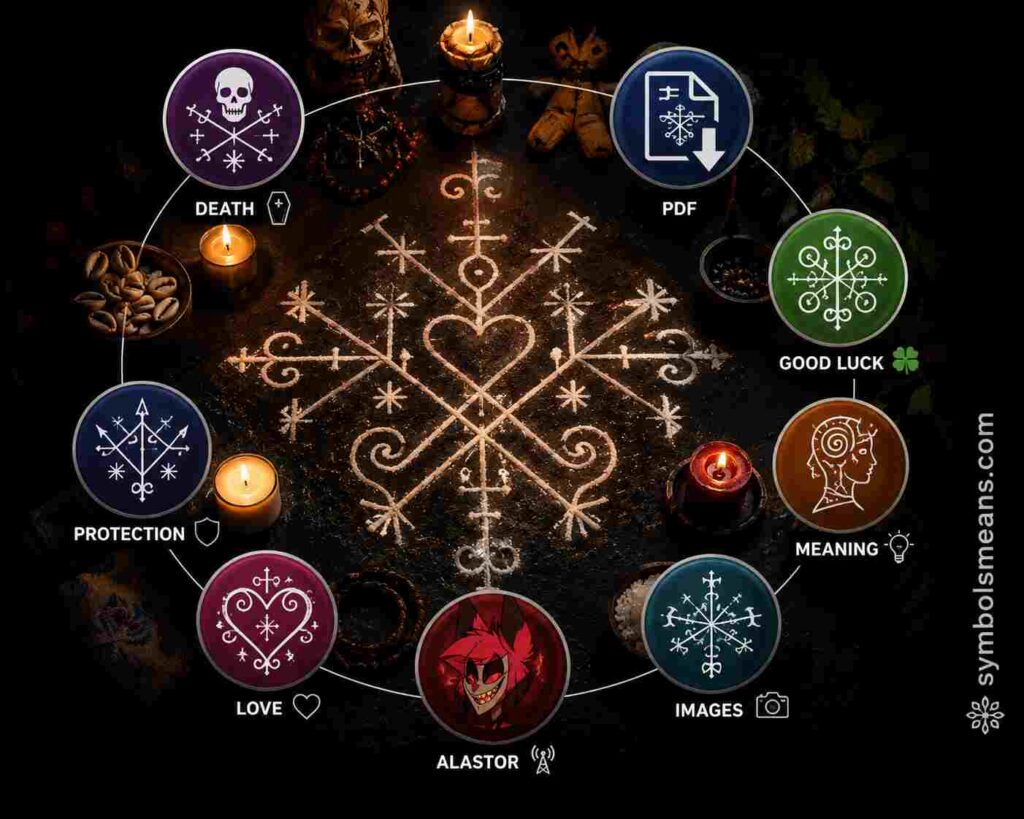
Voodoo Symbols for Death
Symbols tied to death and the afterlife are most associated with Baron Samedi and the Gede spirits, who govern the boundary between life and the spirit world. These veves often include crosses, coffins, and skull imagery.
Voodoo Symbols PDF
Many spiritual shops and cultural sites offer downloadable PDF charts of veves for study or reference. These are useful for recognizing symbols, but learning their ritual use should come from knowledgeable practitioners, not a printout alone.
Voodoo Symbols for Good Luck
Papa Legba and Ayizan are commonly petitioned for luck, new opportunities, and removing obstacles. Their veves are drawn to “open the road” before any positive undertaking.
Voodoo Symbols Meaning
At their core, veves represent a spirit’s personality, domain, and power. A symbol isn’t decorative — every line, shape, and object woven into it carries intentional meaning.
Voodoo Symbols Images
Veve images typically show geometric patterns: crosses, hearts, serpents, and stars, often combined with objects tied to the spirit, such as a cane for Papa Legba or a sword for Ogou.
Voodoo Symbols Alastor
Some fans of animated pop culture associate “voodoo symbols” with Alastor, a character whose design draws loosely on New Orleans Voodoo and radio-demon aesthetics. This is a fictional, stylized reference and not an authentic religious veve.
Voodoo Symbols for Love
Erzulie Freda, the Lwa of love and beauty, is the primary spirit invoked for romance. Her veve typically features an ornate heart, sometimes paired with mirrors or combs symbolizing feminine allure.
Voodoo Symbols for Protection
Ogou, the warrior spirit, and Papa Legba are most frequently called upon for protection. Their veves are believed to act as a spiritual shield against negative energy or harm.
Read More : 95+ Best Taylor Swift Symbols: The Hidden Meanings, Secret Codes and Emotional Stories Behind Every Era
Understanding Voodoo Symbols and Their Meanings
Voodoo Symbols and Meanings
Each Lwa’s veve tells a story through shape and symbolism, directional lines, central objects, and recurring motifs all combine to represent that spirit’s character and powers.
Vodou Symbols
“Vodou” is the more accurate term for the Haitian religious tradition, while “Voodoo” is the popular umbrella term that also covers Louisiana Voodoo and West African Vodun.
Symbols of Voodoo
Beyond veves, Voodoo symbolism includes ritual colors, sacred objects like staffs and chalices, and gestures used during ceremonies, all carrying specific spiritual significance.
Voodoo Religion Symbols
As a religion, Voodoo’s symbols function similarly to icons in other faiths: visual shorthand for theological concepts, spirits, and sacred stories.
Voodoo Religion Symbol
The crossroads — represented in Papa Legba’s veve, is arguably the most central religious symbol, marking the meeting point between the human and spirit worlds.
Voodoo Symbolism Religion Symbols
Symbolism in Voodoo isn’t separate from belief; it’s how belief is practiced. Drawing a veve is considered a sacred act, not merely artistic expression.
Voodoo Symbols and Their Meanings
Understanding a veve means understanding the Lwa behind it, their domain, personality, and the offerings they prefer.
Voodoo Symbols and Meaning
In short: every veve is a spiritual signature, unique to one spirit, used to call them into ceremonial presence.
Types of Voodoo Symbols Around the World
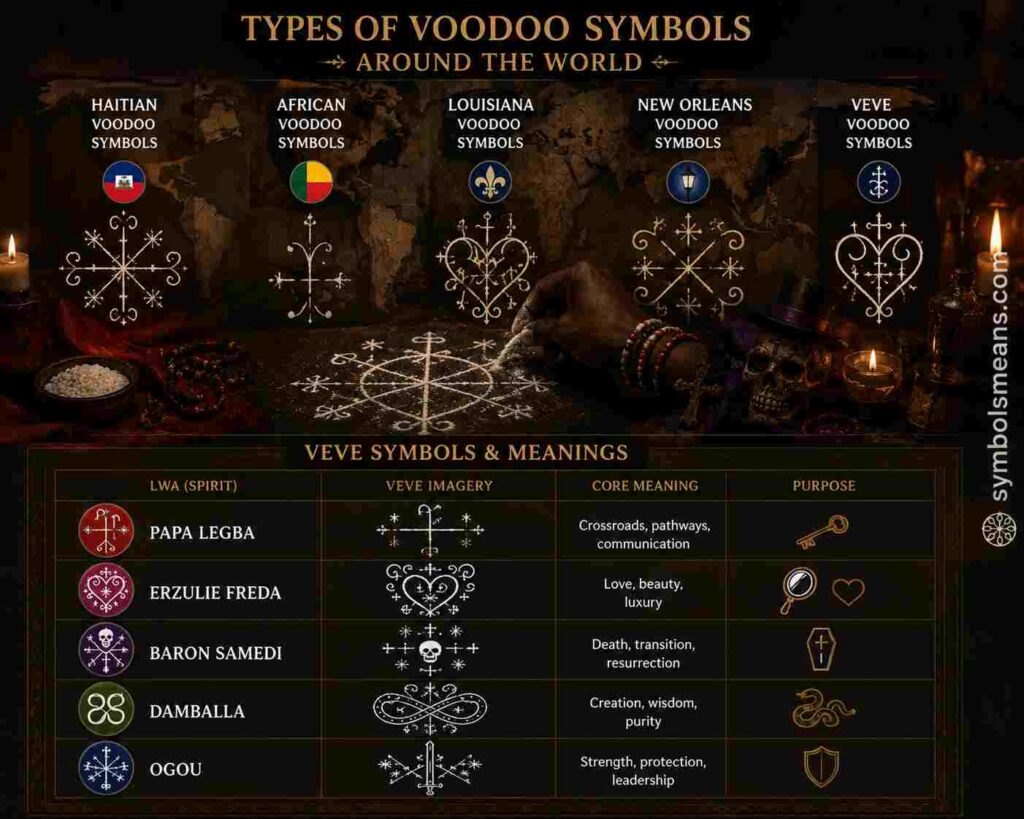
Haitian Voodoo Symbols
Haitian Vodou produced the most widely recognized veves, drawn during ceremonies to honor specific Lwa like Papa Legba, Erzulie Freda, and Baron Samedi.
Haitian Voodoo Symbols and Meanings
Each Haitian veve connects to a defined spirit and purpose, love, protection, death, or wisdom, making the system highly structured despite its visual complexity.
African Voodoo Symbols
West African Vodun, practiced in Benin and Togo, represents the ancestral root of all Vodou traditions. These older symbols tend to be simpler but carry deep historical weight.
Louisiana Voodoo Symbols
Louisiana Voodoo blends Haitian veves with Hoodoo practices and Catholic saint imagery, shaped historically by figures like Marie Laveau in New Orleans.
New Orleans Voodoo Symbols
In modern New Orleans, these symbols appear widely in tattoos, spiritual shops, and artwork, reflecting the city’s living Voodoo culture.
Veve Voodoo Symbols
Veves remain the foundational symbol type across all Voodoo branches, even as regional styles vary slightly.
Voodoo Veve Symbols and Meanings
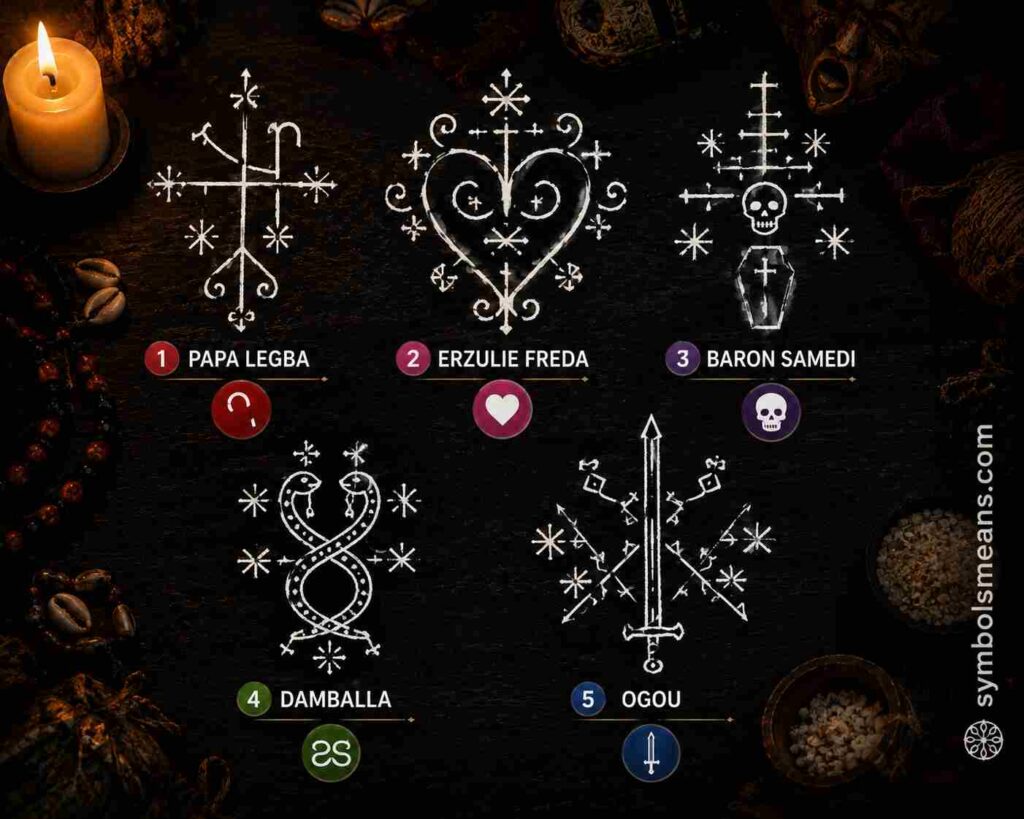
Below is a quick reference table of the most recognized veves:
| Lwa (Spirit) | Veve Imagery | Core Meaning |
|---|---|---|
| Papa Legba | Cross, cane, keys | Crossroads, pathways, communication |
| Erzulie Freda | Ornate heart, mirrors | Love, beauty, luxury |
| Baron Samedi | Cross, coffin, skull | Death, transition, resurrection |
| Damballa | Two intertwined serpents | Creation, wisdom, purity |
| Ogou | Sword, geometric lines | Strength, protection, leadership |
Protection, Signs and Special Voodoo Symbols
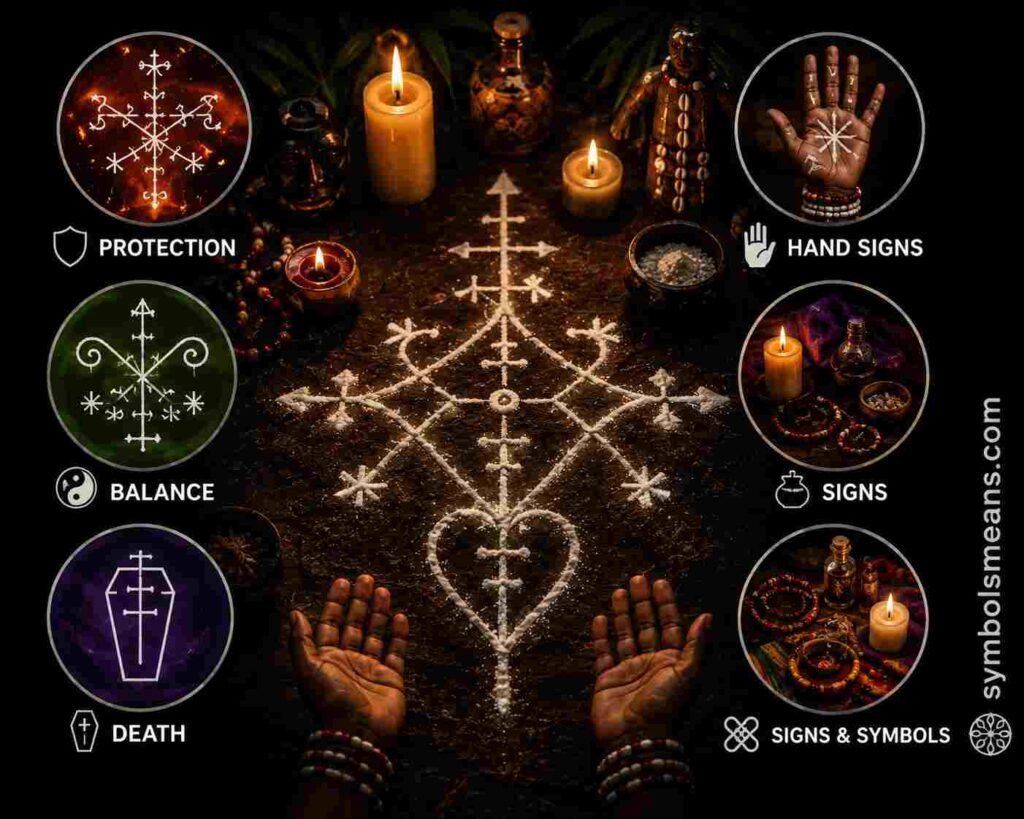
Voodoo Protection Symbols
Ogou Feray’s veve, symbolizing fire and iron, is considered one of the strongest protective symbols, often invoked to shield a person or home.
Voodoo Symbols of Protection
Marasa, the divine twins, represent balance and are also called upon for protective, harmonizing energy.
Voodoo Symbol for Death
Baron Samedi’s veve, combining crosses and coffin imagery, remains the clearest symbol associated with death and the afterlife in Vodou tradition.
Voodoo Hand Signs
Ritual hand gestures are used alongside veves during ceremonies to show respect, signal spiritual status, or invoke specific energies.
Voodoo Signs
“Signs” broadly refers to veves, hand gestures, colors, and ritual objects that together form Voodoo’s symbolic language.
Voodoo Signs and Symbols
These elements work together, a veve alone rarely stands without accompanying offerings, colors, and gestures specific to the spirit being honored.
Unique and Modern Voodoo Symbol Uses
Voodoovoodoo Symbols
This search variation typically points users toward general overviews of veve meanings and symbolic usage across modern spiritual practice.
Voodoo Symbols PNG
Digital PNG versions of veves are popular for design projects, tattoo references, and spiritual study, though authenticity and respectful sourcing matter.
Alastor Voodoo Symbols
As noted earlier, Alastor-related imagery is a fictional pop-culture interpretation, not a traditional religious veve, useful to know if you’re searching for accurate spiritual meaning versus entertainment design.
Deep Symbolic Meaning
On a Spiritual Level
Veves function as portals, believed to open a direct line between the physical world and the spirit realm.
On a Psychological Level
For practitioners, drawing a veve can create focus, intention, and a meditative state that reinforces belief and emotional connection.
On a Cultural Level
These symbols preserve a history of resilience, coded visual language that survived slavery, colonization, and centuries of misrepresentation.
Types and Variations of Voodoo Symbols
1. Papa Legba Veve
Featuring a central cross and cane, this veve represents the crossroads and is drawn first in nearly every ceremony, since no spirit can be reached without his permission.
2. Erzulie Freda Veve
An ornate heart surrounded by mirrors and curls represents love, beauty, and emotional healing.
3. Baron Samedi Veve
Crosses combined with skull and coffin imagery reflect his domain over death, transformation, and dark humor.
4. Damballa Veve
Two intertwined serpents symbolize creation, ancestral wisdom, and the purity of life’s origin.
5. Ogou Veve
A sword paired with geometric lines represents strength, courage, and protective military energy.
Voodoo Symbols Across Cultures
West Africa
Vodun in Benin and Togo forms the ancestral foundation, with simpler but spiritually potent symbols.
Haiti
Haitian Vodou elaborated these roots into the detailed, geometric veve system most people recognize today.
Louisiana
Louisiana Voodoo merges African veves with Catholic and Hoodoo elements, creating a distinct local blend.
Caribbean and Brazil
Related Afro-diasporic traditions like Cuban Santería and Brazilian Candomblé share symbolic roots but use their own distinct sacred signs.
Modern Global Spirituality
Today, veve-inspired designs appear in jewelry, art, and spiritual practice worldwide, often disconnected from formal ritual use.
Voodoo Symbols in Art, Movies and Pop Culture
Hollywood has long misrepresented Voodoo symbols as sinister or evil, fueling myths about curses and dolls that don’t reflect the religion’s true focus on healing and ancestral connection. In contrast, contemporary artists, musicians, and designers increasingly use veve-inspired imagery to celebrate Afro-Caribbean heritage authentically.
Spiritual and Dream Meaning of Voodoo Symbols
In spiritual practice, seeing or dreaming about a veve is often interpreted as a message from a specific Lwa, signaling guidance, a warning, or an invitation to seek protection or clarity in a particular area of life.
Positive vs Negative Meaning
Positive Meaning
Veves represent healing, protection, love, and connection to ancestors — central, affirming aspects of Vodou as a living faith.
Negative Interpretation
Misused or sensationalized in media, these symbols are often wrongly framed as tools of curses, distorting their true devotional purpose.
Why Humans Are Attracted to Voodoo Symbols
People are drawn to Voodoo symbols for their visual mystery, deep history, and the promise of spiritual connection. For some, it’s cultural curiosity; for others, genuine spiritual practice rooted in ancestry and faith.
Frequently Asked Questions About Voodoo Symbols
Are voodoo symbols evil?
No. Veves are sacred religious symbols used for healing, protection, and honoring spirits — not for curses.
What are veves in voodoo?
Veves are ritual drawings that invoke specific Lwa spirits during Vodou ceremonies.
Can anyone draw voodoo symbols?
Veves are traditionally drawn by trained practitioners; casual drawing for study is fine, but ritual use requires proper knowledge.
What does the voodoo cross mean?
The cross typically represents the crossroads, most associated with Papa Legba as the gatekeeper between worlds.
Are voodoo symbols used for protection?
Yes, especially veves linked to Ogou and Papa Legba, which are commonly invoked for spiritual protection.
Conclusion
Voodoo symbols are far more than mysterious drawings, they’re a living spiritual language shaped by centuries of African diaspora history. From Papa Legba’s crossroads to Erzulie Freda’s heart, each veve carries intention, story, and sacred purpose. Approaching them with respect and accurate knowledge honors the culture they come from.