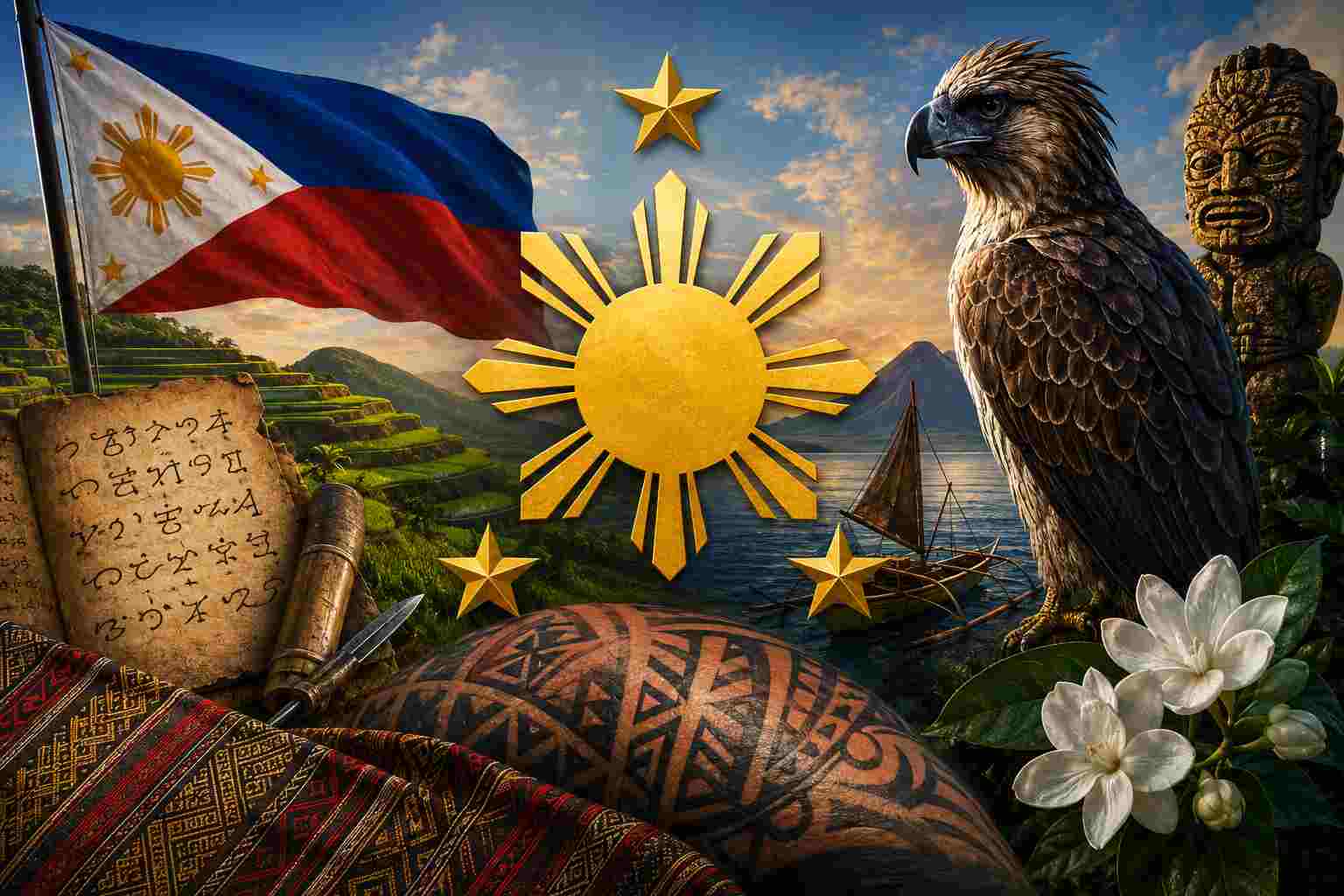
The Philippines carries thousands of years of history in its symbols, from the sun and stars on its flag to ancient scripts carved into bamboo. Many of these symbols are seen every day without anyone stopping to ask what they truly mean. This guide walks through the most important Filipino symbols, their origins, and the deeper stories they still carry today.
What Are Filipino Symbols?
Filipino symbols are the images, scripts, animals, and objects that represent the beliefs, history, and identity of the Filipino people. Some are officially recognized by law, like the national flag and national bird. Others are cultural or indigenous, passed down through oral tradition, tattoo practices, weaving, and folk religion long before they were ever written down.
Together, these symbols tell the story of a nation shaped by pre-colonial animism, centuries of colonization, and a modern movement to reclaim identity that was nearly erased.
Filipino Cultural Symbols And Their Meanings
Filipino symbols and meanings
At the core, most Filipino symbols represent one of a few themes: faith, family, resilience, or nature. A single symbol, like the sun or the Sarimanok, can carry all four meanings depending on where and how it’s used.
Filipino flag
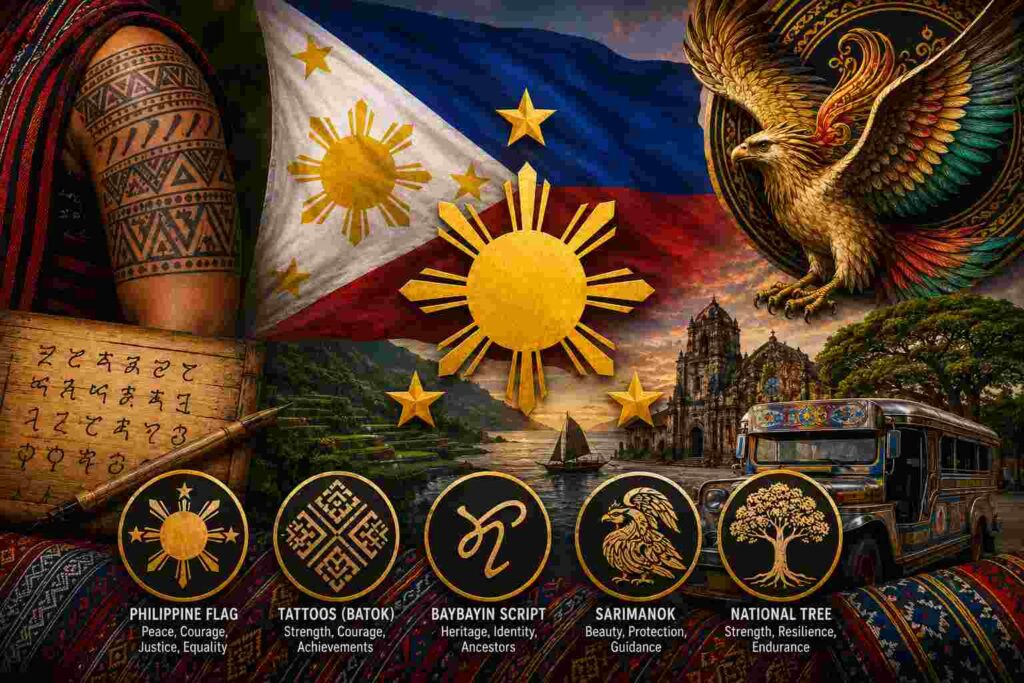
The Philippine flag features a white triangle, a golden sun, three stars, and blue and red horizontal bands. The blue represents peace and justice, the red represents courage, and the white triangle stands for equality and fraternity.
Filipino symbols tattoos
Traditional Filipino tattoos, especially from the Kalinga people of northern Luzon, use geometric batok patterns applied by hand-tapping, historically marking a warrior’s achievements and status within the community.
Filipino symbols tattoos
Beyond Kalinga batok, many modern Filipinos choose Baybayin script tattoos to spell out names or meaningful words, turning body art into a personal reclamation of pre-colonial heritage.
Filipino symbols letters
“Filipino symbol letters” usually refers to Baybayin, the pre-colonial writing system where each character represents a syllable rather than a single letter, unlike the Latin alphabet used today.
Philippines symbols and meanings
Official Philippine symbols, the flag, the national bird, the national tree — are taught in schools specifically to build a shared sense of pride and identity across the archipelago’s diverse regions.
National Symbols Of The Philippines
What are the 10 national symbols of the Philippines
The Philippines has thirteen symbols officially recognized through law, though people often round this to the ten most commonly cited: the flag, the national anthem, the coat of arms, sampaguita (flower), narra (tree), the Philippine eagle (bird), waling-waling (orchid), Philippine pearl (gem), arnis (martial art), and Filipino Sign Language.
Philippine national symbols PDF
Many schools and government sites provide downloadable PDF references listing each official symbol along with its legal basis, most notably under Republic Act 8491, also known as the Flag and Heraldic Code.
Philippines national bird
The Philippine eagle, one of the largest and rarest eagles in the world, was officially declared the national bird and represents strength, freedom, and the country’s rich biodiversity.
philippine national symbols with pictures and description
Visual references pairing each symbol with a short description are popular study tools, commonly used in classrooms to teach the significance of items like the narra tree or the sampaguita flower.
national tree of the philippines
Narra was declared the national tree for its strength, durability, and long lifespan, qualities often used metaphorically to describe Filipino resilience.
Read More : One Piece Symbols | Hidden Meanings, Deep Secrets and the Powerful Messages Behind Them
Ancient And Traditional Filipino Symbols
ancient filipino symbols
Long before colonization, early Filipino communities used symbols tied to animism, the belief that spirits inhabit nature, ancestors, and everyday objects.
filipino symbolism
Mountains, rivers, animals, and the sun were treated as sacred, and symbols representing them were carved, woven, or painted onto tools, homes, and bodies.
traditional filipino symbols
Common traditional symbols include the sun, ocean waves, mountain peaks, the Sarimanok bird, Baybayin characters, and Okir patterns, all still visible in weaving, pottery, and woodwork today.
filipino good luck symbols
The Sarimanok is associated with fortune and blessing, the carabao represents abundance, and anting-anting amulets are widely believed to bring protection and luck.
filipino ancient symbols
Ancient symbols were closely tied to the babaylan, the spiritual leaders of pre-colonial communities, who used symbolic objects in healing and protection rituals.
filipino indigenous symbols
Indigenous symbols vary widely by ethnic group, the Kalinga use batok tattoo patterns, while the Maranao of Mindanao use the Sarimanok and Okir designs.
filipino protection symbols
Anting-anting amulets remain the most recognized protection symbols in Filipino folk belief, often inscribed with prayers, Latin phrases, or symbolic markings believed to ward off harm.
Filipino Symbols Of Identity, Culture And Strength
family filipino symbols and meanings
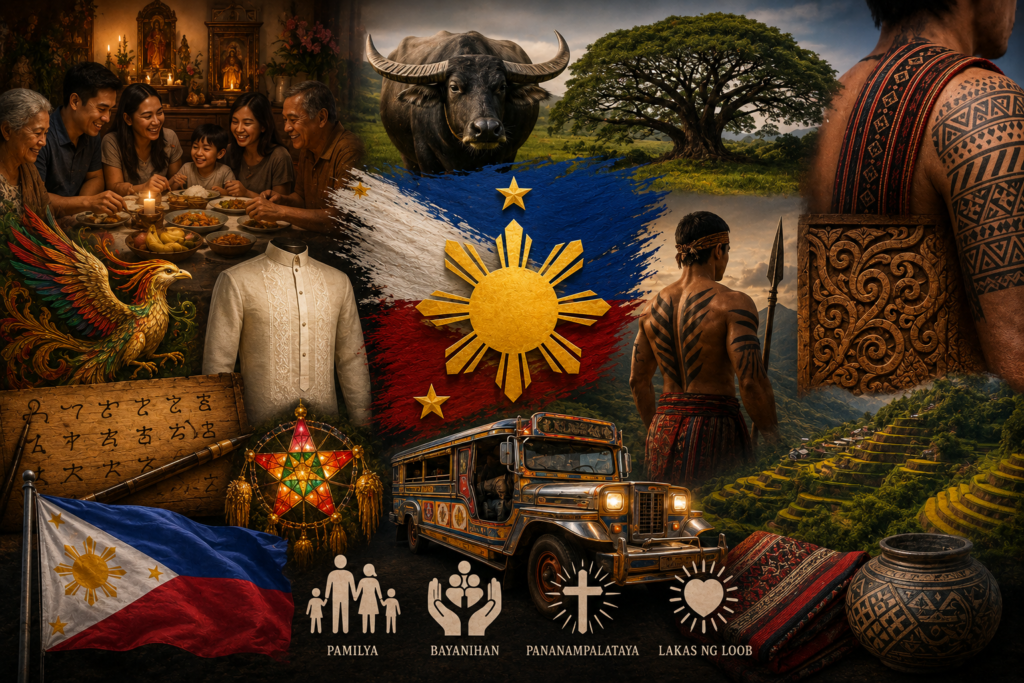
In Filipino tradition, the home altar (dambana) and shared meals during fiestas function as living symbols of family unity and togetherness.
filipino symbols for strength
The carabao, narra tree, and Kalinga batok tattoos are all tied to endurance, representing the physical and cultural strength Filipinos are known for.
symbols that represent filipino culture
The Sarimanok, Baybayin, the Barong Tagalog, and the parol (Christmas lantern) together represent the blend of indigenous heritage and communal celebration found across Filipino culture.
filipino symbols of strength
Painted body markings called patik in Visayan warrior tradition marked the number of battles survived, the more markings, the greater the respect earned.
filipino culture symbols
From the national to the personal, symbols like the flag, the Sarimanok, and Baybayin combine to paint a picture of Filipino identity as a whole.
filipino symbols culture
Everyday objects, not just formal emblems, carry cultural weight, the jeepney and the parol are just as symbolically important as any official national emblem.
indigenous filipino symbols
Mindanao’s Okir carvings and the Cordillera’s rice terraces (a UNESCO World Heritage Site) both represent indigenous artistic and engineering achievement.
symbols of filipino identity
Baybayin script, the national flag, and tribal tattoos all say the same thing in different forms: this is who Filipinos are, and this is where they come from.
symbols of filipino culture
Core Filipino values — pamilya (family), bayanihan (community), pananampalataya (faith), and lakas ng loob (inner strength) — are reflected across nearly every traditional symbol.
More Ancient And Cultural Filipino Symbols
ancient filipino symbols and meanings
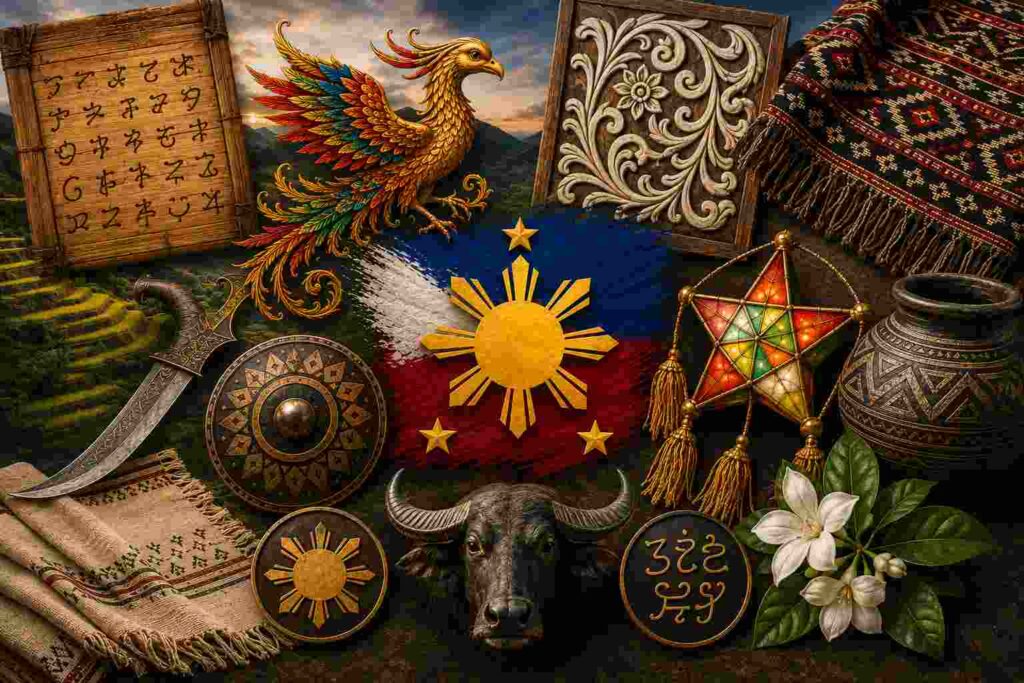
Baybayin, the Sarimanok, and Okir patterns all carry meanings tied to identity, community, and spiritual connection, created long before colonization and still recognized today.
filipino cultural symbols
These symbols function as a bridge between generations, letting modern Filipinos connect to traditions that predate outside influence.
ancient filipino symbols for strength
Warrior-era symbols like the kampilan sword and kalasag shield represented courage and the readiness to defend one’s community.
filipino symbols for family
Shared rituals, food, and communal space, rather than a single image, often serve as the truest symbols of family in Filipino tradition.
traditional filipino symbols and meanings
Traditional symbols consistently point back to themes of protection, gratitude, and connection between people, land, and spirit.
old filipino symbols for strength
Older generations passed down warrior symbols like the batok tattoo specifically to honor survival and resilience within the community.
tagalog family filipino symbols and meanings
In Tagalog households specifically, the dambana (home altar) represents a family’s spiritual anchor and shared devotion.
common filipino symbols
Everyday recognizable symbols include the sun, three stars, Sarimanok, sampaguita, carabao, parol, and Baybayin letters, all appearing across products, art, and government documents.
filipino symbols and practices
Symbols in Filipino culture rarely stand alone; offering flowers to anito figures or wearing anting-anting are practices that give these symbols their living meaning.
warrior filipino symbols
The batok tattoo, kampilan sword, kalasag shield, and babaylan staff were all used by fighters, leaders, and spiritual guides in pre-colonial communities.
philippine filipino symbols
Internationally, the flag’s sun design, the Sarimanok, and Baybayin script remain the most recognized Filipino symbols outside the country.
ilocano ancient filipino symbols and meanings
Ilocano weaving, known as Abel cloth, uses geometric and nature-inspired patterns to represent harvest, community, and humanity’s connection to the earth.
Deep Symbolic Meaning of Filipino Symbols
Spiritual Level
On a spiritual level, Filipino symbols connect the living to ancestors and nature spirits, rooted in the animist belief that everything, rivers, mountains, animals, carries life and meaning.
Psychological Level
Psychologically, these symbols provide a sense of continuity and belonging, especially for younger and diaspora Filipinos reconnecting with heritage that colonization tried to suppress.
Cultural Level
Culturally, symbols like Baybayin and the Sarimanok represent resilience and revival, proof that indigenous identity survived centuries of outside influence.
Types and Variations of Filipino Symbols
Sarimanok
A legendary bird from Maranao mythology, the Sarimanok is depicted holding a fish in its beak or talons and is associated with good fortune, prestige, and divine communication between the human and spiritual worlds.
Sun and Stars of the Philippine Flag
The eight-rayed sun represents the first provinces that revolted against Spanish rule, while the three stars represent the major island groups: Luzon, Visayas, and Mindanao.
Anito Figures
Anito figures were carved to house the spirits of ancestors or nature beings, representing respect for lineage and the unseen world in pre-colonial belief systems.
Okir Patterns
Okir refers to flowing, plant-inspired carvings found in Maranao and other Mindanao artistic traditions, symbolizing life force, continuity, and social status.
Baybayin Script
Baybayin is the pre-colonial writing system of the Philippines, with each character representing a syllable. Today, it stands as one of the strongest symbols of cultural reclamation and pride.
Filipino Symbols Across Cultures
Filipino symbolism isn’t uniform across the archipelago, it shifts by region and ethnic group. The Maranao of Mindanao contributed the Sarimanok and Okir traditions, the Kalinga of the Cordillera developed batok tattooing, and the Ilocano created intricate Abel weaving patterns. Even after Spanish colonization introduced Christian symbols, many blended with existing indigenous ones rather than replacing them entirely, creating the layered symbolism seen in Filipino culture today.
Filipino Symbols in Art, Movies and Pop Culture
Modern Filipino and Filipino-American artists frequently use Baybayin, the Sarimanok, and Okir patterns as tools of cultural expression rather than decoration, appearing in murals, gallery exhibitions, and clothing design. Symbols like the Sarimanok have also entered mainstream media, most notably as a long-running broadcast mascot for a major Philippine television network. On social media, hashtags related to Baybayin and Filipino tribal tattoos consistently generate strong engagement, especially among younger Filipinos exploring their heritage.
Spiritual and Dream Meaning of Filipino Symbols
In Filipino folk belief, these symbols often appear in dreams as meaningful messages rather than random imagery. The Sarimanok is interpreted as a sign of divine attention or a coming transition, Baybayin often signals ancestral contact, and anito figures are understood as ancestors checking in on living descendants.
Positive vs Negative Meaning
Most Filipino symbols carry overwhelmingly positive associations, protection, gratitude, and pride, but meaning can shift depending on region and context. A pattern seen as a symbol of courage in one province might carry a very different, even solemn, meaning in another, which is why understanding local context matters before adopting any traditional design.
Why Humans Are Attracted to Symbols of Filipino Culture
People are drawn to these symbols because they carry entire histories in a single image, a Baybayin character can represent centuries of resilience, and a Sarimanok can represent an entire region’s mythology. For many Filipinos, especially those living abroad, wearing or displaying these symbols is a way of saying: this heritage belongs to me, and I choose to carry it forward.
FAQs About Filipino Symbols
What are the most important Filipino symbols?
The flag, the Sarimanok, Baybayin script, and the Philippine eagle are among the most recognized and important Filipino symbols.
Are Filipino symbols religious?
Some are tied to animist and folk-Catholic beliefs, while others, like national symbols, are secular and represent shared identity rather than religion.
Why is Baybayin popular today?
Baybayin represents cultural revival and pride, giving modern Filipinos a way to reconnect with pre-colonial identity.
Do Filipino symbols have meanings in dreams?
Yes, many symbols like the Sarimanok and anito figures are believed to carry spiritual messages when they appear in dreams.
Can non Filipinos use Filipino symbols?
Respectful use with genuine understanding and appreciation is generally welcomed, though context and meaning should be researched first.
Are Filipino symbols still used today?
Yes, they appear in art, fashion, tattoos, education, and national celebrations across the Philippines and its global diaspora.
Conclusion
Filipino symbols are more than decoration, they are quiet storytellers carrying faith, resilience, and pride across generations. From the sun on the flag to the ancient strokes of Baybayin, each one connects present-day Filipinos to ancestors, warriors, and artists who refused to let their identity disappear. Understanding these symbols isn’t just a history lesson; it’s a way of recognizing the enduring heartbeat of Filipino culture itself.