Buddhist symbols have quietly shaped art, jewelry, tattoos, and home decor for over 2,500 years. From the Dharma Wheel painted on temple gates to the lotus flower inked on someone’s wrist, these images carry layers of meaning that go far beyond decoration. This guide breaks down the most important Buddhist symbols and meanings, including the sacred 8 Symbols of Buddhism, protection symbols, tattoo meanings, and how these signs are used across Tibetan, Chinese, Japanese, and Thai traditions, so you can understand exactly what you’re looking at, and why.
What Are Buddhist Symbols and Meanings?
Buddhist symbols are visual representations of core teachings, enlightenment, compassion, impermanence, and the path out of suffering. Unlike a single “Buddhist flag” or logo, Buddhism uses a whole visual language: wheels, flowers, animals, and geometric knots that each encode a specific idea from the Buddha’s teachings (the Dharma).
They aren’t meant to be worshipped as objects. They’re teaching tools, visual shorthand that helps practitioners remember a principle at a glance.
Understanding Buddhist Symbols And Their Deep Meanings
Every Buddhist symbol works on more than one level. A lotus isn’t just “a flower that means purity” , it’s a reminder that beauty and clarity can grow out of difficult conditions (mud), which mirrors the human journey toward enlightenment.
What Are The 8 Symbols Of Buddhism?
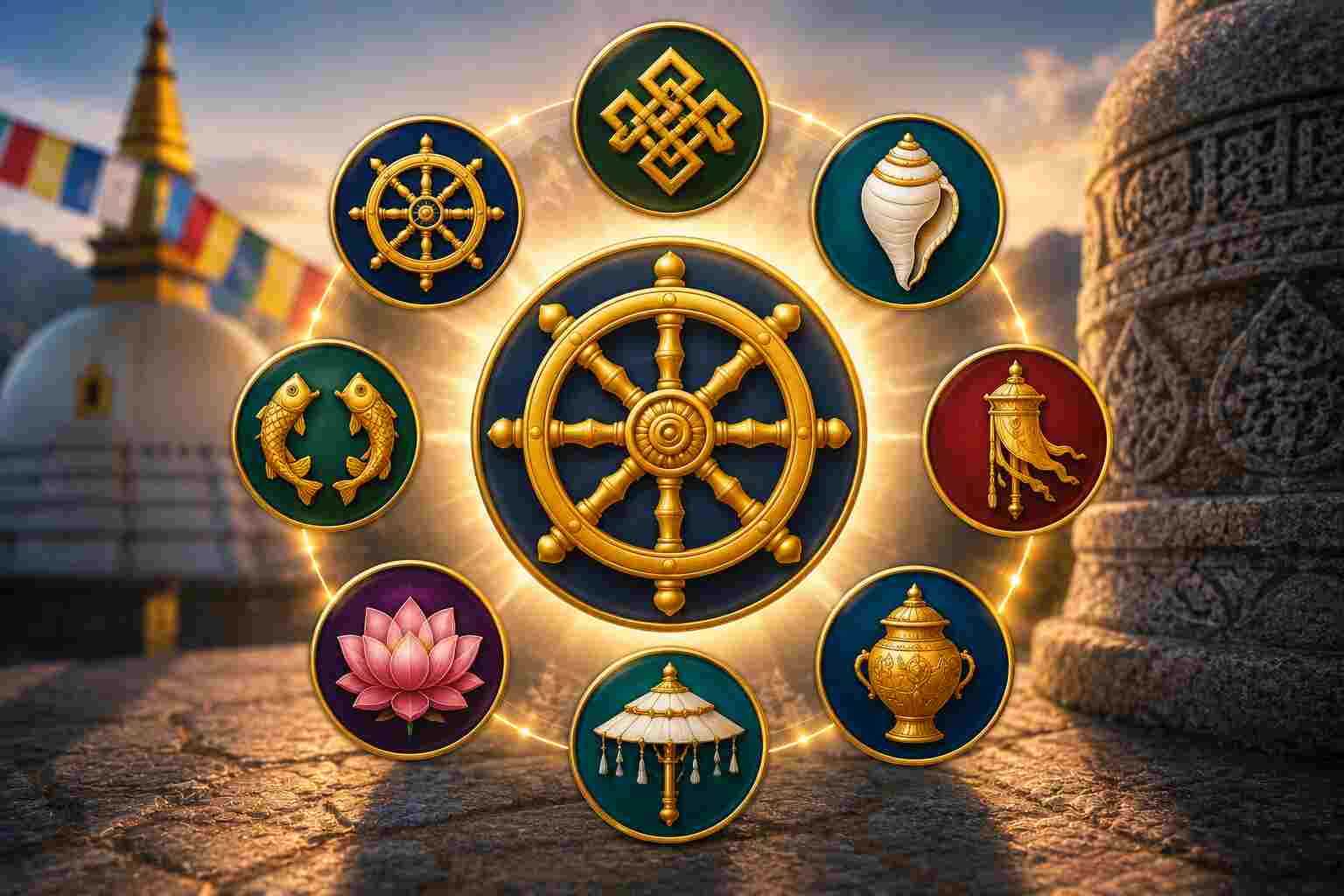
The 8 Symbols of Buddhism, known as the Ashtamangala (Eight Auspicious Signs), are said to represent the gifts offered to the Buddha by celestial beings after he reached enlightenment.
8 Symbols Of Buddhism And What They Mean
| Symbol | Meaning |
|---|---|
| Dharma Wheel (Dharmachakra) | The Buddha’s teachings and the Noble Eightfold Path |
| Lotus Flower | Purity and spiritual awakening rising above suffering |
| Conch Shell | The far-reaching sound of the Dharma awakening beings from ignorance |
| Endless Knot | Interdependence, wisdom joined with compassion |
| Golden Fish (pair) | Freedom, fearlessness, and happiness |
| Treasure Vase | Spiritual abundance that never runs dry |
| Victory Banner | Triumph over ignorance, fear, and obstacles |
| Parasol/Umbrella | Protection from suffering and negative forces |
5 Symbols Of Buddhism
If you’re looking for a shorter, “core five,” most teachers point to the Lotus Flower, the Dharma Wheel, the Bodhi Tree, the Buddha image, and the Endless Knot, the five most universally recognized across all Buddhist schools, from Theravada to Zen.
Read More : 68+ Powerful Voodoo Symbols: The Hidden Meanings, Secrets and Spiritual Power Behind Every Sign for 2026
Popular Buddhist Symbols And Their Uses In Daily Life
These symbols show up everywhere from meditation cushions to wedding rings. Here’s how the same core meanings get applied to different everyday searches and use cases.
Buddhist Symbol Of Life
The Endless Knot is often called the Buddhist symbol of life because it has no beginning and no end, representing the continuous cycle of birth, death, and rebirth (samsara), and the interconnectedness of all existence.
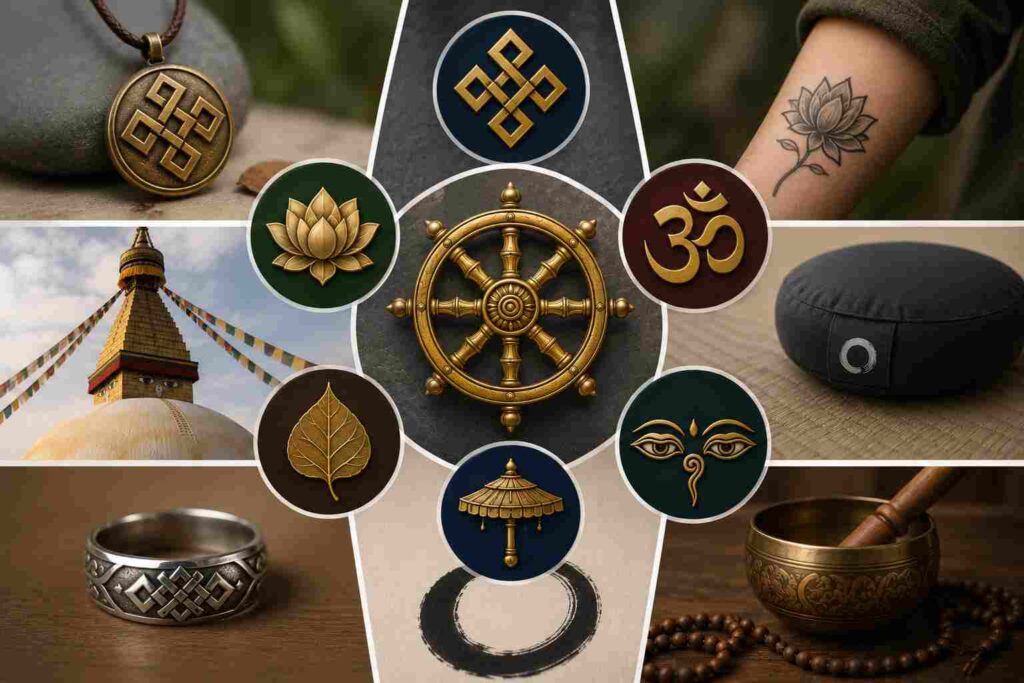
Buddhist Symbols And Meanings For Tattoos
Popular tattoo choices include:
- Lotus flower : growth through hardship
- Om symbol : the sound of the universe
- Dharma Wheel : staying on the right path
- Bodhi leaf : awakening and clarity
- Endless knot : an unbreakable bond or journey
Buddhist Symbols Images
Most searches for “Buddhist symbol images” are looking for the lotus, the Dharma Wheel, the Buddha’s eyes (as seen on Nepali stupas), the Om symbol, or the Bodhi tree, all widely used in art, textiles, and temple architecture.
Buddhist Protection Symbols
The Parasol/Umbrella and the Dharmachakra are the two most common protection symbols, believed to shield the mind from harmful forces, illness, and suffering, both worldly and spiritual.
Buddhist Symbol For Love
The Endless Knot doubles as a symbol of love because its interwoven lines represent two lives (or ideas) bound together without a beginning or end, a popular choice for wedding jewelry.
Zen Buddhist Symbols
Zen Buddhism favors minimalist symbols: the Enso (a hand-drawn circle representing enlightenment, the universe, and imperfection accepted as whole), along with the lotus and simple ink-brush Buddha portraits.
Deep Symbolic Meaning of Buddhist Symbols
To really understand these symbols, it helps to look at three layers of meaning at once.
Spiritual Level
On the spiritual level, symbols like the lotus and Dharma Wheel point directly to enlightenment, the end goal of the Buddhist path, and freedom from the cycle of suffering.
Psychological Level
Psychologically, symbols act as anchors for meditation. Focusing on an Enso or a Buddha image helps quiet the mind and interrupt anxious or repetitive thought patterns.
Cultural Level
Culturally, these symbols became identity markers, appearing on flags, temple architecture, currency, and clothing across Asia, adapting slightly in style from Tibet to Japan to Thailand while keeping their core meaning intact.
Types and Variations of Buddhist Symbols and Meanings
1. The Dharma Wheel (Dharmachakra)
Represents the Buddha’s teachings; its eight spokes symbolize the Noble Eightfold Path toward the end of suffering.
2. The Lotus Flower
Grows from muddy water into a clean, fragrant bloom, a metaphor for enlightenment rising out of suffering. Different lotus colors (white, pink, blue, red) carry slightly different meanings, from purity to wisdom.
3. The Buddha Image
Statues and paintings of the Buddha aren’t idols; they’re meditation aids, each hand gesture (mudra) representing a different teaching, such as fearlessness, meditation, or teaching itself.
4. The Endless Knot
A closed, continuous pattern symbolizing the interdependence of all phenomena, and the union of wisdom and compassion.
5. The Bodhi Tree
The fig tree under which the Buddha attained enlightenment; it represents awakening, wisdom, and spiritual shelter.
6. The Stupa
A dome-shaped shrine that houses relics and symbolizes the Buddha’s enlightened mind, often the physical center of pilgrimage and prayer.
Buddhist Symbols and Meanings Across Cultures
| Region | Signature Symbols | Distinct Focus |
|---|---|---|
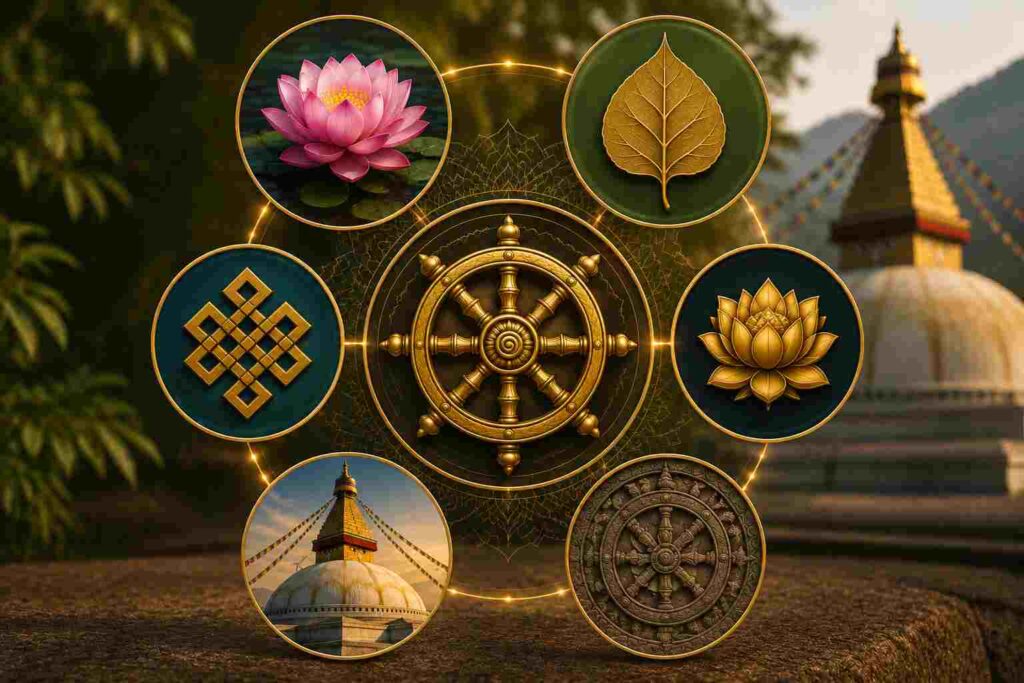
| Ancient India | Dharma Wheel, Lotus, Bodhi Tree | Origin points of Buddhist iconography |
| Tibetan Culture | Ashtamangala, Endless Knot, prayer flags | Protection, ritual, and mandala art |
| Chinese Buddhism | Lotus, swastika (wan), Guanyin imagery | Compassion and harmony with local Taoist motifs |
| Japanese Buddhism | Enso, Bodhi leaf, torii-adjacent Zen art | Simplicity, mindfulness, and Zen minimalism |
| Modern Global Culture | Om, lotus, Buddha statues, mandalas | Wellness, mindfulness, tattoos, home decor |
Ancient India
This is where the core symbols, the Dharma Wheel, the Lotus, and the Bodhi Tree, first emerged directly from the Buddha’s life and early teachings.
Tibetan Culture
Tibetan Buddhism layered on the Ashtamangala, colorful prayer flags, and intricate mandalas, using symbols as active ritual tools rather than passive decoration.
Chinese Buddhism
Chinese Buddhism blended native symbolism (like the swastika, an ancient sign of good fortune long before its 20th-century misuse in the West) with imported Indian motifs, especially around the compassion figure Guanyin.
Japanese Buddhism
Japanese Zen Buddhism stripped symbols down to their essence, the Enso circle is the clearest example, favoring simplicity over ornate detail.
Modern Global Culture
Today, symbols like the lotus and Om appear far outside religious contexts, in yoga studios, jewelry, and wellness branding, sometimes controversially detached from their original Buddhist meaning.
Buddhist Symbols in Art, Movies and Pop Culture
Buddhist imagery regularly appears in film, fashion, and design, from mandala patterns in album art to lotus motifs in interior design and Enso circles used as minimalist logos. This crossover has helped these symbols become globally recognizable, even among people unfamiliar with Buddhist teachings, though it has also sparked ongoing conversations about respectful use versus surface-level trend-borrowing.
Spiritual and Dream Meaning of Buddhist Symbols
Seeing a lotus, Buddha statue, or wheel in a dream is often interpreted (in spiritual and folk traditions, not clinical psychology) as a sign of personal growth, an invitation to slow down, or a signal that clarity is emerging after a difficult period. These interpretations vary widely by tradition and shouldn’t be treated as universal fact.
Positive vs Negative Meanings of Buddhist Symbols
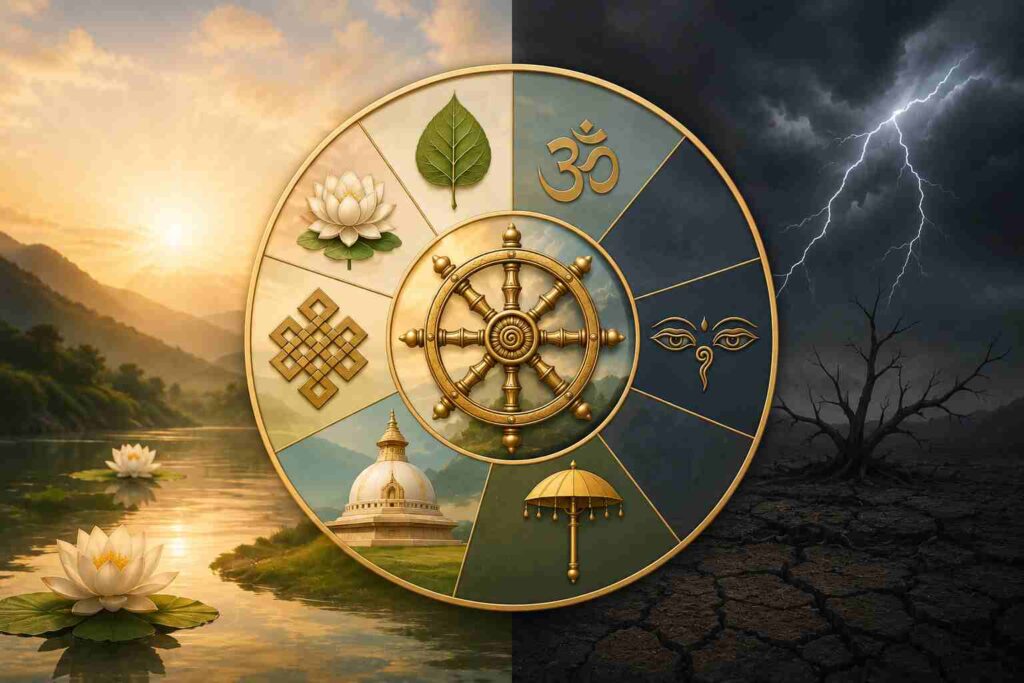
Positive Meanings
- Enlightenment and awakening
- Protection from harm
- Compassion and interconnectedness
- Purity rising from hardship
- Inner peace and balance
Negative or Shadow Meanings
Few Buddhist symbols carry an inherently “negative” meaning, but some, like the swastika, have been culturally distorted outside their original context, causing confusion or discomfort. It’s worth knowing a symbol’s full history before using it decoratively.
Why Humans Are Drawn to Buddhist Symbols
People gravitate toward these symbols because they offer something modern life often lacks: stillness, visual simplicity, and a reminder that growth is possible even from difficult circumstances. Whether it’s a lotus tattoo after a hard year or a small Buddha statue on a desk, these symbols function as quiet daily anchors for calm and intention — no religious commitment required.
FAQs About Buddhist Symbols and Meanings
1. What is the most important Buddhist symbol?
The Dharma Wheel is generally considered the most central, since it directly represents the Buddha’s teachings and the path to enlightenment.
2. Are Buddhist symbols religious or spiritual?
They’re both, rooted in Buddhist religious practice, but widely used today in a broader, non-religious spiritual or mindfulness context.
3. Can non-Buddhists use Buddhist symbols?
Yes, generally, as long as they’re used respectfully and not in ways that mock or trivialize their sacred meaning.
4. What does the lotus symbolize in Buddhism?
Purity and enlightenment, the idea that beauty and clarity can grow out of difficult, muddy conditions.
5. Do Buddhist symbols have healing power?
There’s no scientific evidence of literal healing power; their value lies in the calm, focus, and mindfulness they can inspire.
6. Is it disrespectful to get Buddhist symbols as tattoos?
Not inherently, but it’s respectful to understand the meaning first and avoid placements or combinations that feel mocking or careless.
Conclusion
Buddhist symbols endure because they compress centuries of philosophy into a single, memorable image. Whether you’re drawn to the lotus for its story of growth, the Dharma Wheel for its teaching path, or the Endless Knot for its message of connection, understanding the meaning behind the image turns a nice picture into something genuinely worth carrying with you, on your skin, your shelf, or your mind.