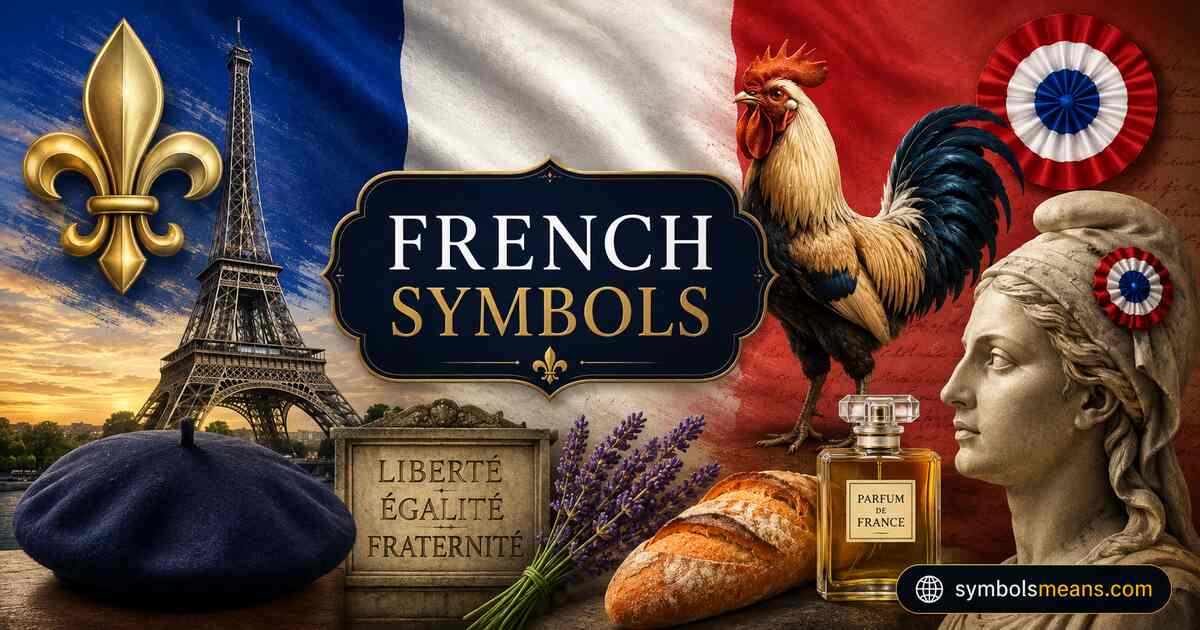
From the fleur-de-lis on a royal crest to the rooster crowing on a football jersey, French symbols carry centuries of monarchy, revolution, and pride. Some represent the nation officially. Others live in everyday language, food, and fashion. This guide breaks down the most important French symbols, their true meanings, and why they still shape how the world sees France in 2026.
What Are French Symbols?
French symbols are the images, figures, and icons that represent France’s history, government, and cultural identity. Some, like the tricolor flag, are constitutionally recognized. Others, like the Gallic rooster or the beret, are unofficial but instantly recognizable worldwide.
Together, these symbols capture a nation shaped by monarchy, revolution, and reinvention, each era leaving its own mark on how France represents itself, both to its own citizens and to the rest of the world.
French Symbols And Meanings Guide
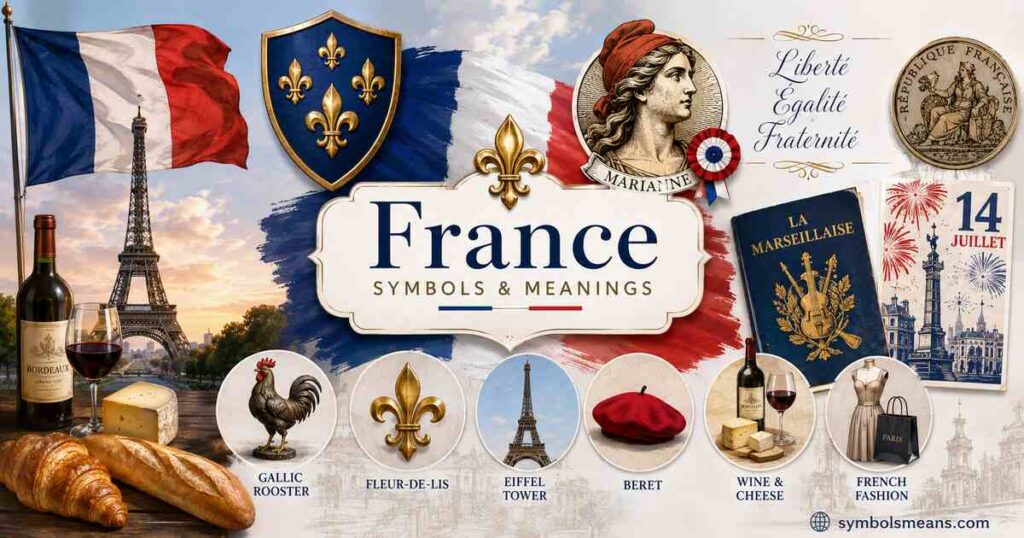
French Symbols And Meanings
At their core, French symbols represent one of a few themes: royal heritage, revolutionary ideals, or cultural pride. The fleur-de-lis reflects centuries of monarchy, while Marianne and the tricolor flag represent the republic that replaced it.
National Symbols In France
Officially recognized national symbols include the tricolor flag, the national motto Liberté, Égalité, Fraternité, the anthem La Marseillaise, the Great Seal, and Bastille Day.
France Symbols
Beyond official emblems, France is represented globally by cultural shorthand, the Eiffel Tower, the baguette, and the beret, recognized even by people with no formal knowledge of French history.
Symbols Of France
Civic symbols used by the state exist alongside lifestyle symbols like wine, cheese, and haute couture, which arguably shape France’s global image even more than any government emblem.
Iconic French Symbols
The Eiffel Tower, the Gallic rooster, Marianne, the fleur-de-lis, and the tricolor flag consistently top the list of France’s most iconic and recognized symbols.
Famous French Symbols
Marianne and the rooster appear on coins, stamps, and sports jerseys, giving them visibility most national symbols never achieve outside their home country.
Popular French Symbols
Among younger generations and tourists, the Eiffel Tower and the beret tend to dominate — simple, visual shorthand that instantly signals “France” anywhere in the world.
Traditional French Symbols
Traditional symbols like the fleur-de-lis and royal coats of arms reflect France’s monarchy-era identity, before the revolution reshaped national symbolism entirely.
Ancient French Symbols
Long before France existed as a nation, ancient Gaul used its own symbolism, Celtic torcs, boar imagery, and Druidic motifs tied to Gallic warrior culture.
Ancient French Symbols And Meanings
In ancient Gaul, symbols represented rank and courage rather than nationhood. Torcs signaled status, and the boar represented bravery in battle.
Old French Symbols
Monarchy-era symbols like the fleur-de-lis, the oriflamme battle banner, and royal coats of arms dominated French heraldry until the revolution swept them aside after 1789.
Medieval French Symbols
During the medieval period, knights displayed heraldic devices on shields and banners, while the fleur-de-lis marked royal authority across the Capetian and Valois dynasties.
French Cultural Symbols
Cultural symbols extend well beyond politics, wine, cheese, café culture, and the French language itself are all recognized globally as markers of French identity.
French Culture Symbols
Everyday objects like the baguette and the beret carry just as much symbolic weight internationally as any official government emblem.
Symbols Of French Culture
Fashion, cuisine, and art combine to create a cultural symbolism that often overshadows France’s formal political emblems in the eyes of the rest of the world.
Things That Represent France
Croissants, cafés, the Eiffel Tower, and the French flag are among the most commonly cited answers when people are asked to picture France instantly.
What Are Some French Symbols?
Common answers include the Eiffel Tower, the tricolor flag, the fleur-de-lis, the Gallic rooster, and Marianne — the five names that appear on nearly every list of French icons.
Read More : 74+ Best Sleep Token Symbols | Hidden Meanings, Sacred Geometry and the Dark Poetry Behind the Mask
French Language And Keyboard Symbols
French Symbols On Keyboard
French computers typically use the AZERTY keyboard layout, which rearranges several keys compared to the standard QWERTY layout used in English-speaking countries.
French Symbols Letters
French relies on several accented letters that don’t exist in English, including é, è, ê, ë, ç, â, î, ô, and û, along with the ligatures œ and æ.
French Symbols E
The letter “e” alone appears in four accented forms, é (accent aigu), è (accent grave), ê (accent circonflexe), and ë (tréma), each guiding a different pronunciation.
French Symbols Over Letters
Accent marks change more than pronunciation; several completely change a word’s meaning, making correct accent placement essential for anyone learning French.
French Symbols Copy And Paste
For typing on devices without a French keyboard layout, many people copy and paste accented characters directly, or use Alt codes like Alt+0233 for é on Windows.
Artistic And Popular French Symbols
French Symbols Drawing
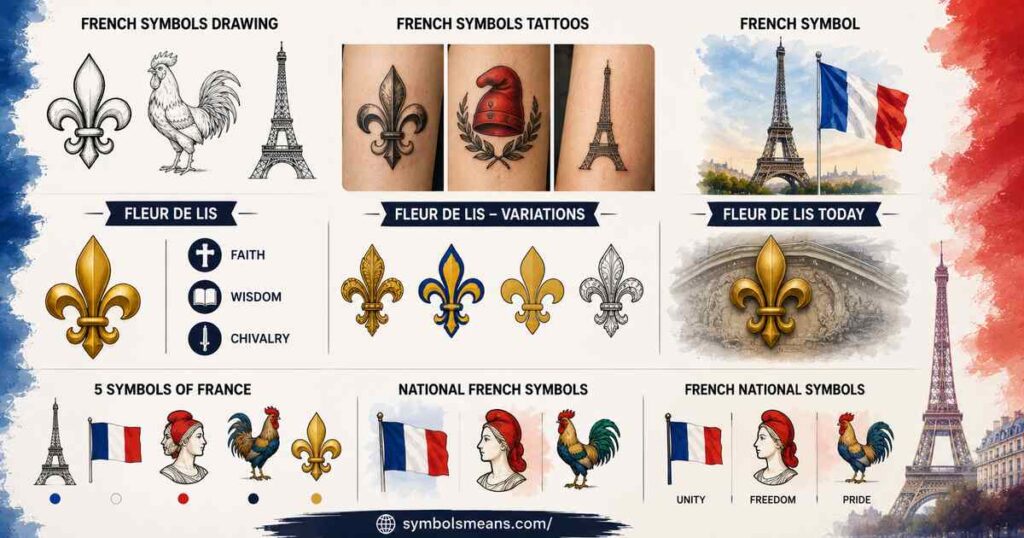
Simple line-art versions of the fleur-de-lis, rooster, and Eiffel Tower are popular in illustration and design work aimed at evoking French elegance quickly.
French Symbols Tattoos
Common tattoo choices include the fleur-de-lis, the Phrygian cap, and small Eiffel Tower silhouettes, each representing heritage, freedom, or personal connection to France.
French Symbol
If asked to name just one, most people point to either the Eiffel Tower or the tricolor flag as the single most recognizable French symbol.
Fleur De Lis French Symbols
The fleur-de-lis, a stylized three-petal lily, became linked to French royalty under the Capetian dynasty in the 12th century, with its petals traditionally read as faith, wisdom, and chivalry.
Fleur De Lis Fleur De Lis French Symbols
Variations of the fleur-de-lis appear throughout French heraldry, architecture, and even international flags and crests influenced by French royal history.
French Symbols Fleur De Lis
Despite losing its official status after the 1789 revolution, the fleur-de-lis remains one of the most recognized symbols of French heritage worldwide.
5 Symbols Of France
The five most cited French symbols are the Eiffel Tower, the tricolor flag, Marianne, the Gallic rooster, and the fleur-de-lis.
National French Symbols
Constitutionally, only the tricolor flag is formally recognized under Article 2 of the French Constitution, though Marianne and the rooster function as de facto national symbols.
French National Symbols
Together, these symbols represent unity, freedom, and pride, reflecting both France’s revolutionary past and its modern republican values.
Deep Symbolic Meaning
Spiritual Level
On a spiritual level, symbols like the Phrygian cap and the rooster’s crow are often read as signs of awakening and liberation from oppression.
Psychological Level
Psychologically, national symbols like Marianne or the flag work by creating shared identity, triggering a sense of belonging and continuity across generations.
Cultural Level
Culturally, symbols like the baguette or beret succeed because they’re simple and repeatable — easy for global media and tourism to use as instant shorthand for France.
Types and Variations of French Symbols
Fleur-de-lis
A stylized lily long associated with French royalty, historically linked to purity, light, and divine authority under the monarchy.
Gallic Rooster
Rooted in a Latin wordplay, “gallus” meaning both rooster and Gaul, this unofficial emblem represents courage, vigilance, and national pride, still worn on French sports jerseys today.
Marianne
The female personification of the French Republic, typically shown wearing a red Phrygian cap, representing liberty, equality, and reason.
Tricolor Flag
Adopted in 1794, the blue, white, and red flag represents the union of the revolutionary people with the historic colors of Paris and the monarchy, now standing for liberty and unity.
Cross of Lorraine
Adopted by Charles de Gaulle and the Free French forces during World War II, this symbol represented French resistance and defiance against Nazi occupation.
French Symbols Across Cultures
Ancient France
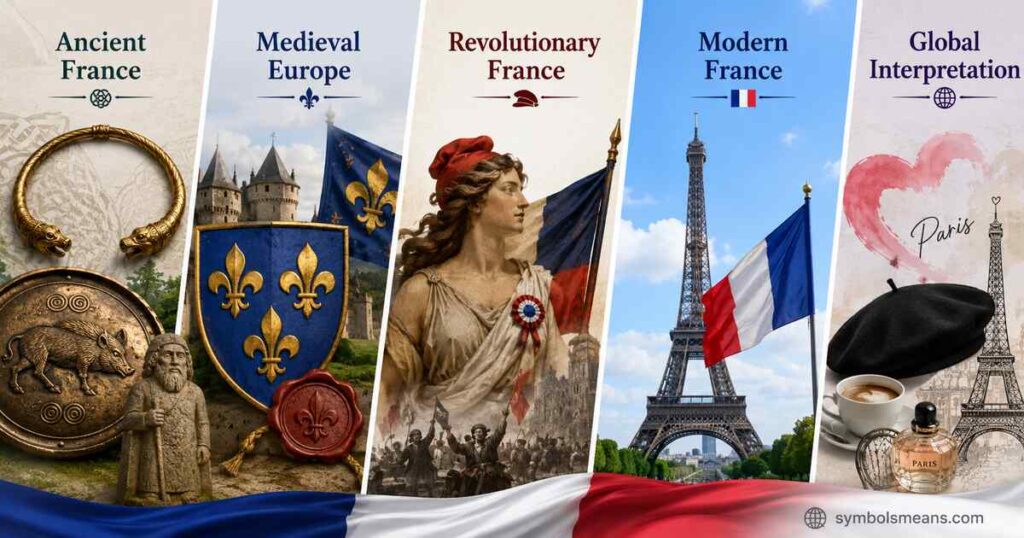
Ancient Gaul used torcs, boar imagery, and Druidic motifs to represent rank, courage, and tribal identity long before modern France existed.
Medieval Europe
Heraldic symbols like the fleur-de-lis marked royal authority and noble lineage across shields, banners, and seals throughout the medieval period.
Revolutionary France
The revolution replaced royal symbolism entirely, introducing Marianne, the tricolor flag, and the Phrygian cap as emblems of liberty and republican government.
Modern France
Today’s France balances constitutional symbols like the flag with cultural icons like the Eiffel Tower, representing both governance and everyday national pride.
Global Interpretation
Internationally, French symbols are often read through a lens of romance and sophistication, with the beret and Eiffel Tower functioning as global shorthand for Parisian elegance.
French Symbols in Art, Movies and Pop Culture
French symbols appear constantly across global film and art, often used to instantly set a tone of romance, mystery, or elegance, a simple Eiffel Tower silhouette can evoke Parisian charm in seconds. In fashion, French luxury brands have turned national symbolism into a global export, blending heritage with modern design. Even in animation and advertising, the beret and baguette remain go-to visual cues whenever a scene needs to say “France” without a single word of dialogue.
Spiritual and Dream Meaning of French Symbols
In symbolic interpretation, the rooster’s crow is often read as a call to awakening, while the tricolor flag can reflect questions of identity or inner conflict. Spiritually, these symbols are sometimes associated with moments of transformation, guiding interpretation toward clarity and purpose. As with most national symbolism, meaning shifts depending on personal and cultural context.
Positive vs Negative Meaning
Positive Meaning
- Liberty, equality, and unity (flag, Marianne)
- Courage and vigilance (Gallic rooster)
- Elegance and cultural pride (fleur-de-lis, Eiffel Tower)
- Resistance and resilience (Cross of Lorraine)
Negative Meaning
- The fleur-de-lis, once a symbol of divine royal authority, also represented rigid class hierarchy under the monarchy
- Revolutionary symbols carry a history of violent upheaval alongside their message of liberty
- Colonial-era use of French national symbols remains a sensitive topic in parts of the world with a complicated relationship to French history
Why Humans Are Attracted to French Symbols
People are drawn to French symbols because they simplify complex history and emotion into elegant, recognizable images. A fleur-de-lis carries centuries of royal heritage in a single shape, while Marianne represents an entire revolution in one figure. Beyond history, these symbols carry an aura of romance and sophistication that continues to attract global fascination, offering a sense of beauty, identity, and belonging that feels distinctly French.
FAQs
What is the most famous French symbol?
The Eiffel Tower and the tricolor flag are generally considered the most famous and recognized French symbols worldwide.
What does the French rooster symbolize?
The Gallic rooster represents courage, vigilance, and national pride, rooted in a Latin wordplay connecting “rooster” and “Gaul.”
Why is Marianne important in France?
Marianne personifies the French Republic itself, representing liberty, equality, and reason across town halls, coins, and official government imagery.
Are French symbols used in modern culture?
Yes, they appear widely in fashion, tourism, sports branding, and global media as instant visual shorthand for French identity.
What do French symbols mean spiritually?
Many are interpreted as signs of awakening, liberation, or transformation, particularly symbols tied to the revolution like the Phrygian cap.
Conclusion
French symbols carry the story of a nation that reinvented itself, from royal lilies and heraldic crests to a revolution that replaced monarchy with liberty, equality, and fraternity. Whether it’s Marianne’s quiet strength, the rooster’s proud crow, or the Eiffel Tower rising over Paris, these symbols continue to define French identity both at home and around the world.