What Are Life Symbols?
Life symbols are visual signs or images that represent the concept of living , its cycles, energy, growth, transformation, and spiritual essence. They appear across nearly every culture on Earth and span thousands of years of human history.
These symbols aren’t just decorative. They communicate deep truths about birth, death, renewal, and everything in between. A circle with no end speaks of eternity. A tree with deep roots speaks of strength and ancestry. People use them in tattoos, jewelry, art, architecture, and spiritual practice to anchor their beliefs in something timeless.
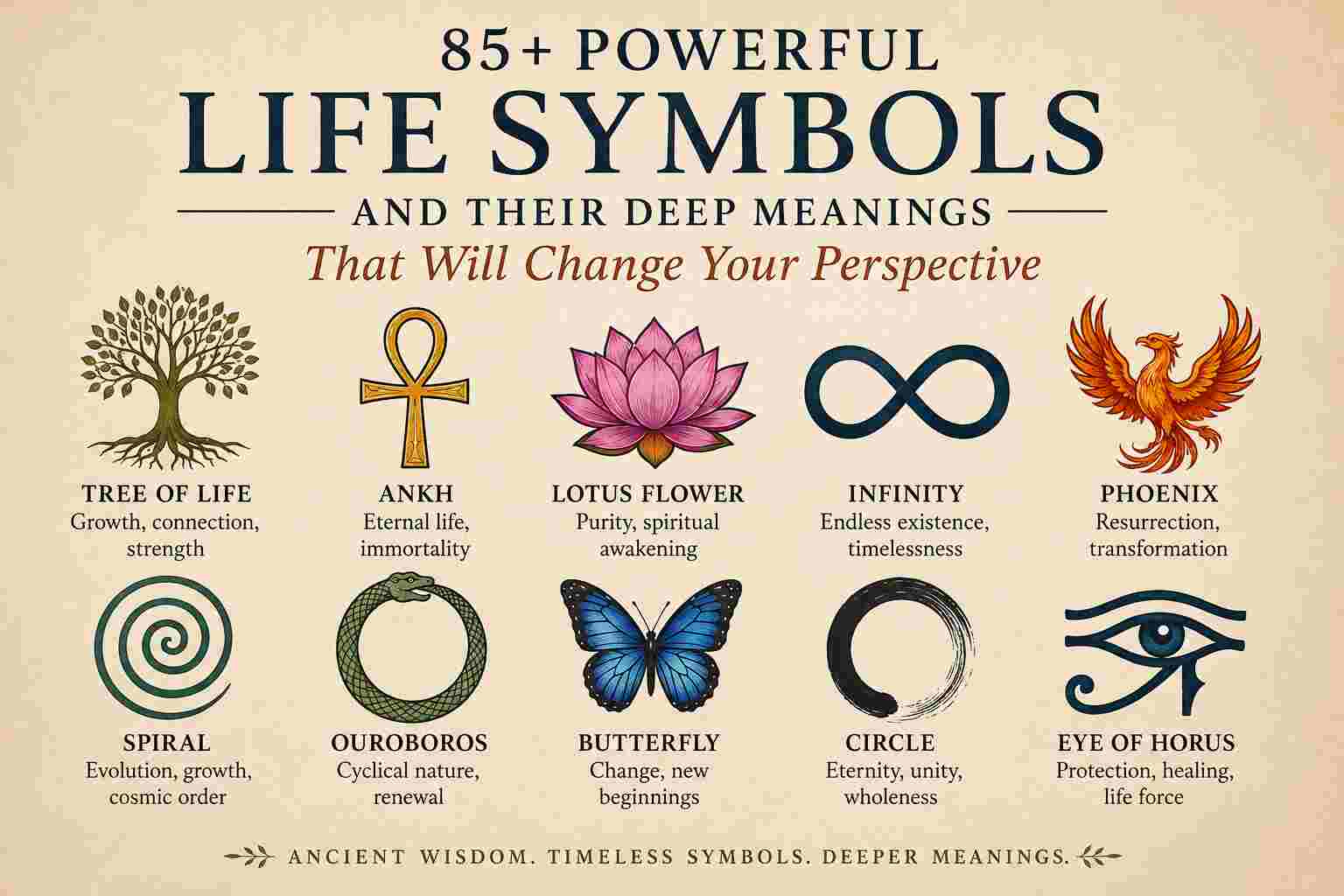
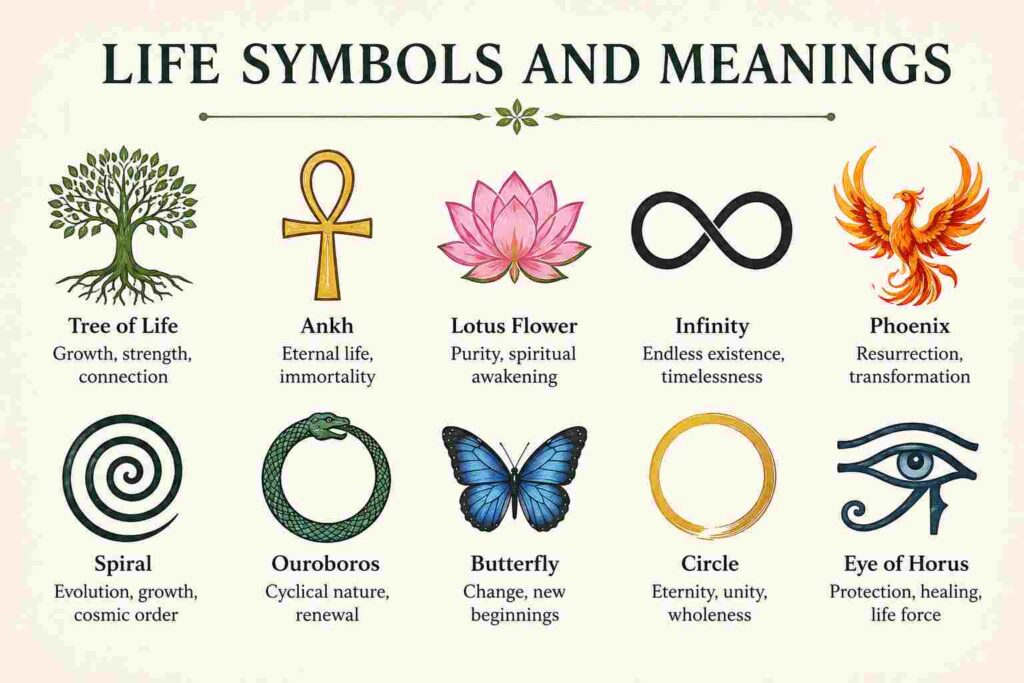
Life Symbols and Meanings
Here is a quick reference table of the most recognized life symbols and what they represent:
| Symbol | Origin | Core Meaning |
|---|---|---|
| Ankh | Ancient Egypt | Eternal life, immortality |
| Tree of Life | Universal | Growth, connection, rebirth |
| Infinity (∞) | Mathematics/Spiritual | Endless existence, timelessness |
| Lotus Flower | Hindu/Buddhist | Purity, spiritual awakening |
| Phoenix | Greek/Egyptian | Resurrection, transformation |
| Spiral | Celtic/Universal | Evolution, growth, cosmic order |
| Ouroboros | Egyptian/Greek | Cyclical nature, renewal |
| Butterfly | Universal | Change, new beginnings |
| Circle | Universal | Eternity, unity, wholeness |
| Eye of Horus | Ancient Egypt | Protection, healing, life force |
Tree of Life Symbols
The Tree of Life is one of the oldest and most widespread symbols in human history. It appears in Celtic mythology, Norse legend (as Yggdrasil), Jewish mysticism (Kabbalah), and Indigenous cultures across the Americas.
What makes this symbol so enduring? A tree lives in two worlds at once , its roots dig into the dark earth while its branches reach toward the sky and light. This duality speaks to the human experience itself: grounded in the physical world yet reaching toward something greater.
Tree of Life Symbols and Meanings
- Roots: Ancestry, foundation, hidden strength
- Trunk: Stability, resilience, the present moment
- Branches: Growth, possibility, spiritual aspiration
- Leaves: Life force, renewal with each season
- Fruit: Wisdom and the rewards of sustained effort
The Tree of Life also represents the four classical elements , earth (roots), water (sap), air (branches), and fire (sunlight that feeds it).
Eternal Life Symbols
Eternal life is one of humanity’s oldest obsessions. These symbols capture that desire across different traditions:
- Ankh : The Egyptian “key of life,” representing immortality
- Infinity Symbol (∞) : Mathematical and spiritual endlessness
- Ouroboros : The serpent eating its own tail, symbolizing endless cycles
- Circle : No beginning, no end; the perfect shape of eternity
- Phoenix : Dies and is reborn, representing undying resilience
Symbols of Life
Life symbols broadly fall into several categories based on what aspect of existence they highlight:
- Renewal symbols : Phoenix, butterfly, sunrise
- Growth symbols : Tree of Life, bamboo, spiral
- Eternal existence symbols : Ankh, infinity, ouroboros
- Sacred geometry symbols : Flower of Life, Seed of Life, Mandala
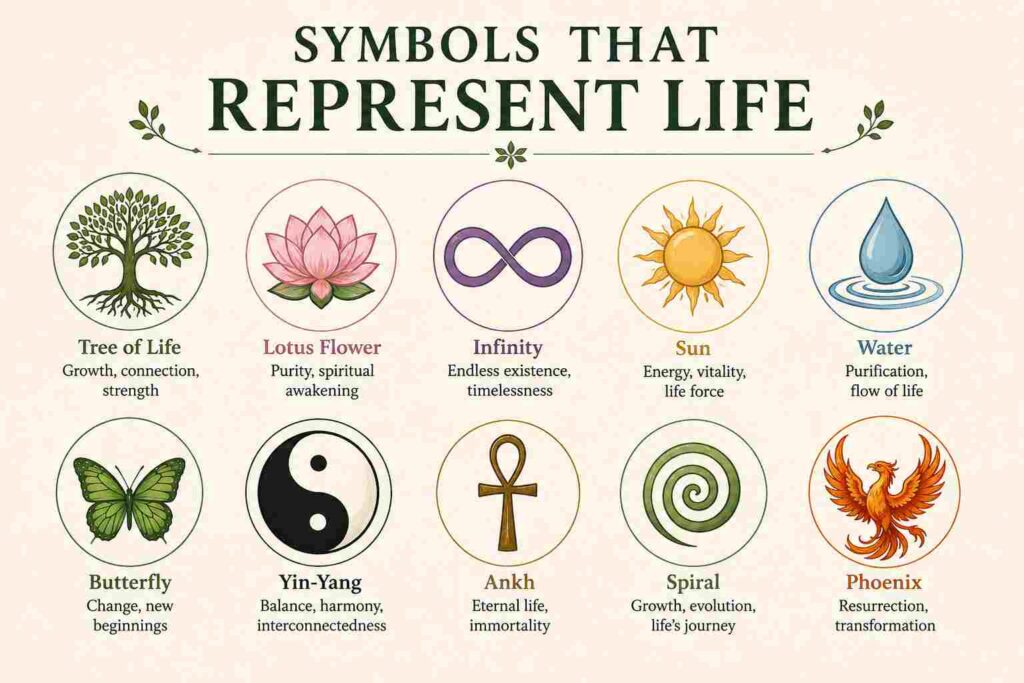
- Natural world symbols : Sun, water, lotus flower
What Symbolizes Life
Several natural elements have symbolized life across virtually every culture:
- Sun : The ultimate source of energy and growth; worshipped from ancient Egypt to the Aztec Empire
- Water : In Christianity it represents purification; in many Eastern traditions it symbolizes the flow of existence
- Fire : Warmth, energy, transformation
- Seeds : Contained potential; all of life from a single point
Symbol of Life
If you had to choose one universal symbol for life, the Ankh and the Tree of Life compete for that title. The Ankh is arguably the oldest dedicated symbol of life, while the Tree of Life is the most cross-cultural and emotionally resonant.
Life Symbols and Meanings
Each symbol carries layers of meaning that shift depending on context, culture, and personal interpretation. What unites them is the human need to visualize something as vast and complex as life itself.
Symbols for Life
Beyond the famous ones, here are additional symbols frequently used to represent life:
- Dove : Peace, new beginnings, the soul
- Green color : Growth, nature, vitality
- Heart : Love as the essence of living fully
- Hamsa Hand : Protection, health, and life force
- Yin-Yang : Balance of opposing forces that sustain life
- Scarab Beetle : Renewal and the morning sun
Symbol for Change in Life
Change is inseparable from life. These symbols specifically represent transformation and new chapters:
- Butterfly : The metamorphosis from caterpillar to winged beauty is the perfect metaphor for personal change
- Phoenix : Destruction followed by rebirth
- Spiral : Evolution that always moves forward even while circling back
- Autumn Leaves : Letting go as a necessary part of renewal
Symbols That Have Deep Meaning
Some symbols carry meaning so dense they seem to hold entire philosophies within a single image:
- Mandala : Represents wholeness, the cosmic universe, and inner peace
- Labyrinth : Used by the Hopi people as a symbol of life’s complex journey; also found in ancient European cultures
- Caduceus : Two serpents on a staff, representing healing and the balance of opposing forces
- Om (ॐ) : In Hindu tradition, the primordial sound of creation itself
Things That Represent Life
Life shows up in unexpected symbols throughout everyday culture:
- A green sprout pushing through cracked concrete
- A heartbeat line (EKG wave) in modern medical and memorial contexts
- Water droplets in environmental and spiritual design
- The DNA double helix — the literal molecular blueprint of all living things
What Represents Life
Life is represented differently across belief systems:
- In Christianity, the cross and the fish (Ichthys) represent spiritual life
- In Buddhism, the lotus and the dharma wheel represent the path of life
- In Hinduism, the Om symbol and the lotus hold deep life symbolism
- In Indigenous cultures, animals like the eagle, turtle, and bear represent different aspects of life’s journey
Things That Symbolize Life
Objects and natural phenomena that carry life symbolism in art, literature, and everyday culture:
- Candles (the flame of life)
- Seeds and sprouting plants
- Running water and rivers
- The sunrise
- Green landscapes and forests
- The human heartbeat
Symbol of Life Meaning
At its core, a symbol of life points toward two things: existence (the fact of being alive) and vitality (the quality of living fully). The most powerful life symbols capture both dimensions simultaneously.
Symbol for Life
The most commonly used single symbol for life across modern culture is the Ankh, followed closely by the infinity symbol and the Tree of Life. In medical and scientific contexts, the double helix or the heartbeat line serves this function.
Read More : Winter Symbols Explained | The Spiritual Messages of Snow, Fire and Silence for 2026
Symbols That Represent Life
Here is an expanded list across different contexts:
| Context | Symbol Used |
|---|---|
| Spiritual | Lotus, Om, Ankh, Tree of Life |
| Modern Tattoo | Semicolon, Phoenix, Butterfly |
| Ancient Cultures | Scarab, Djed Pillar, Ouroboros |
| Nature-Based | Sun, Water, Green Leaf, Seed |
| Pop Culture | Heartbeat line, DNA strand |
What Symbol Represents Life
The Ankh is the most direct answer — it was literally created to mean “life” as an Egyptian hieroglyph. However, the Tree of Life is the most universally understood across cultures and time periods.
Powerful Symbols with Deep Meanings
Some symbols transcend their original culture to carry meaning for all of humanity:
- Yin-Yang : The eternal interplay of opposing forces
- Ouroboros : The universe in constant self-renewal
- Mandala : Infinite patterns reflecting cosmic order
- Phoenix : Rising above destruction every single time
- Om : The sound of the universe before anything existed
Symbol That Represents Life
Across tattoo culture, jewelry design, and spiritual practice, the Tree of Life has emerged as the single most used modern symbol for life. Its adaptability — it works across Celtic, Buddhist, Jewish, Norse, and Indigenous traditions — makes it uniquely universal.
Symbols Representing Life
Life symbols work on multiple levels simultaneously:
- Personal : Representing your own story and journey
- Cultural : Connecting you to your heritage
- Spiritual : Linking you to something beyond the physical
- Universal : Bridging language, geography, and time
Objects That Represent Life
Everyday objects have carried life symbolism throughout history:
- The hourglass : Time passing; life’s finite nature
- The lamp or torch : The light of life; knowledge keeping darkness at bay
- The mirror : Reflection, identity, consciousness
- The key : Opportunity, unlocking potential (the Ankh itself was called “the key of life”)
Symbols Meaning Life
A helpful categorization of life symbols by what aspect they emphasize:
Cycle of Life: Ouroboros, Wheel of Fortune, Spiral New Life: Egg, Seed, Sunrise, Butterfly Eternal Life: Ankh, Infinity, Circle Quality of Life: Lotus, Heart, Dove
Symbolism for Life
Symbolism around life often centers on three core themes: continuity (life goes on), transformation (life changes), and connection (life links all beings).
What Symbolises Life
Across global traditions, these elements most commonly symbolize life:
- Light (especially sunlight)
- Water (especially flowing water)
- Green growing things
- The breath
- The heartbeat
Symbolism of Life
The symbolism of life is not just about existing , it’s about the quality and meaning of existence. That’s why symbols like the lotus (which grows from mud to bloom in beauty) and the phoenix (which rises from ash) are more powerful than simple representations of biological function. They capture the emotional and spiritual truth of what it means to be alive.
Thing That Represent Life
Some of the most powerful representations of life come from unexpected places:
- The semicolon in modern culture represents choosing to continue your story
- The green ribbon symbolizes life in mental health advocacy
- The heartbeat tattoo has become a modern memorial symbol
- The dandelion , resilient, spreading seeds of new life even in harsh conditions
Greek Life Symbols
Ancient Greece contributed several enduring life symbols to Western culture:
Greek Life Symbols and Meanings
The Ankh-Style Cross (Sometimes Confused)
While the Ankh is Egyptian, Greek Christians adopted a similar looped cross called the “crux ansata,” blending Egyptian and Greek symbolic traditions around eternal life.
The Greek Key (Meander)
This repeating geometric pattern found on Greek pottery symbolizes infinity and the eternal flow of life. It appears in temples, textiles, and architecture across the ancient Greek world.
The Owl
Sacred to Athena, the owl represents wisdom , the quality that makes human life distinctly meaningful. It appears on Athenian coins and remains a symbol of intellectual life today.
The Olive Branch
One of the most enduring Greek contributions, the olive branch symbolizes peace, fertility, and the abundance that makes life worth living. It was awarded to Olympic victors and offered to the gods.
Flower of Life Symbols
The Flower of Life is a sacred geometry pattern consisting of overlapping circles arranged in a hexagonal grid. It appears in:
- Ancient Egyptian temples (Osiреion at Abydos)
- Leonardo da Vinci’s notebooks
- Hindu, Buddhist, and Jewish mystical traditions
It is believed to contain the patterns of all living things within its geometry — a visual representation of the mathematics underlying life itself.
Pro Life Symbols
In modern cultural and political discourse, several symbols have become associated with the pro-life movement:
- The Forget-Me-Not flower : Remembrance and the preciousness of life
- The Fetal Feet : A pin worn to represent the value of unborn life
- White roses : Purity and the sanctity of life
- The Celtic Cross : In some contexts used to represent life’s sacred nature
Spiritual Life Symbols and Meanings
Lotus Flower
The lotus grows from murky water and blooms into a pristine flower without a trace of the mud on its petals. In Buddhism and Hinduism, this represents the soul’s journey from ignorance to enlightenment , from suffering to liberation.
Tree of Life
Across spiritual traditions worldwide, the Tree of Life connects the underworld (roots), the human world (trunk), and the divine realm (branches and crown). It is a spiritual map of existence.
Infinity Symbol
Originally a mathematical concept introduced in 1655, the infinity symbol (∞) was adopted by spiritual traditions to represent the idea that consciousness or the soul has no true endpoint.
Spiral
Spirals appear in Celtic knotwork, Native American art, and ancient cave paintings. Spiritually, the spiral represents the soul’s journey — always moving forward, growing outward, returning to source.
New Life Symbols
Butterfly
The butterfly is nature’s most elegant metaphor for transformation. A caterpillar dissolves almost entirely inside its chrysalis before reforming into something completely new. This mirrors the human experience of going through periods of darkness before emerging changed and free.
Sunrise
Every sunrise represents a new beginning , proof that darkness always gives way to light. Across cultures, the dawn has been worshipped and celebrated as a symbol of renewed life and fresh possibility.
Egg
The egg holds everything needed for new life in a small, fragile shell. It appears in creation myths worldwide — from the Cosmic Egg of Hindu cosmology to the Easter traditions of Christianity — as a symbol of potential waiting to emerge.
Phoenix
The phoenix is the defining symbol of new life rising from destruction. According to ancient myth, this magnificent bird lives for five hundred years before burning itself to ash , then rises again, reborn and renewed. Its story is the ultimate metaphor for resilience.
Base 12 Eternal Life Symbols
In numerology and sacred geometry, the number 12 carries deep symbolic weight (12 months, 12 zodiac signs, 12 disciples). Base 12 eternal life symbols include:
- The 12-pointed star (representing cosmic completeness)
- The 12-petal lotus in Hindu tradition
- The 12 gates of the New Jerusalem in Christian symbolism
- Zodiac wheels representing the complete cycle of life’s seasons
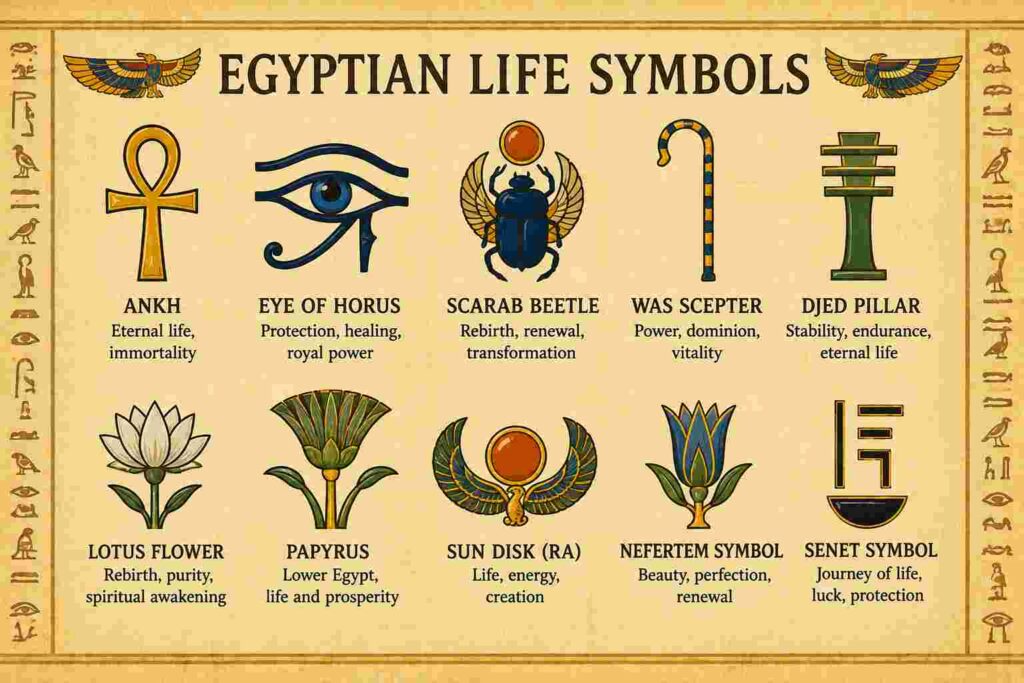
Egyptian Life Symbols
Ancient Egypt produced some of the most sophisticated and enduring life symbolism in human history, driven by their intense focus on the afterlife and immortality.
The Ankh
The Ankh (☥) is a cross with a loop at the top. As an Egyptian hieroglyph, it literally means “life.” Gods were depicted holding ankhs to signify their power to grant life. It appeared on tomb walls, jewelry, and temple carvings throughout ancient Egypt. The Coptic Christians of Egypt later adapted it into their own cross — the crux ansata.
The Scarab Beetle
The scarab rolls dung into a ball and pushes it along the ground , an action the Egyptians associated with the sun god Khepri rolling the sun across the sky each day. The scarab became a powerful symbol of renewal, resurrection, and the morning sun bringing new life.
The Djed Pillar
The Djed pillar represents stability and endurance , the backbone of Osiris, god of the afterlife. It symbolizes life’s ability to remain upright and resilient through all challenges.
The Eye of Horus
Also called the Wedjat, the Eye of Horus represents healing, protection, and the restoration of life. According to myth, Horus lost his eye in battle and it was magically restored , making it a symbol of recovery and renewed vitality.
Life Symbols With Meaning
Every life symbol points beyond itself to something lived and felt. The most meaningful symbols are those that connect personally — that reflect your own story of growth, loss, resilience, or transformation.
Life Symbols Casket Corners
In funeral traditions, life symbols are often carved or placed on casket corners to represent the deceased’s belief in eternal life or the continuation of the soul. Common choices include:
- Angels (spiritual eternal life)
- The Tree of Life (roots and branches connecting all realms)
- The Ankh (eternal existence)
- Flowers (beauty of life that was lived)
- The infinity symbol (love and life without end)
Life Life Symbols and Meanings
This doubling of emphasis captures something important: life symbols are about life and for life — they serve the living just as much as they honor the dead. They give the living a language for hope, meaning, and perseverance.
Everyday Life Symbols
Life symbolism shows up in daily life more than most people realize:
- The green traffic light : permission to move forward, live actively
- A coffee cup at sunrise : ritual marking the start of a new day
- Blooming flowers on a windowsill : life persisting indoors
- A child’s drawing of the sun : instinctive life symbolism in its purest form
Real Life Symbols
Real-life symbols differ from mythological ones in that they’re drawn directly from observable nature:
- Running rivers : life in motion, always flowing forward
- Migrating birds : the seasonal rhythms of existence
- The beating heart on a monitor : the most direct confirmation of life
- A mother nursing a child : the literal transmission of life from one being to another
Meaning of Life Symbols
The meaning behind life symbols is never fixed , it shifts with personal experience, cultural context, and historical period. What remains constant is the function: these symbols help humans process the enormity of being alive and give shape to feelings that resist ordinary language.
Real Life Symbols of Rebellion
Some symbols have been reclaimed as acts of defiance , asserting the right to live fully, freely, and on one’s own terms:
- The raised fist : solidarity, fighting for the right to live with dignity
- The rainbow flag : living authentically without apology
- The semicolon : choosing to continue your story when the impulse is to stop
- The red poppy : life honored in the face of death and war
Deep Symbolic Meaning of Life Symbols
Spiritual Meaning
Spiritually, life symbols act as bridges between the visible and invisible worlds. They remind practitioners that physical existence is just one layer of a much larger reality. Meditating on a lotus or mandala is believed to quiet the mind and connect the practitioner to deeper dimensions of consciousness.
Psychological Meaning
Carl Jung identified what he called “archetypes” , universal symbols that appear in the dreams and myths of all cultures. Life symbols like the tree, the circle, and the serpent appear across his work as fundamental expressions of the human psyche’s way of understanding existence, growth, and transformation.
Cultural Meaning
Culturally, life symbols are identity markers. They carry thousands of years of ancestral wisdom in a single image. When someone wears a Celtic Tree of Life or an Egyptian Ankh, they are connecting to a lineage of human beings who found meaning in the same image across centuries.
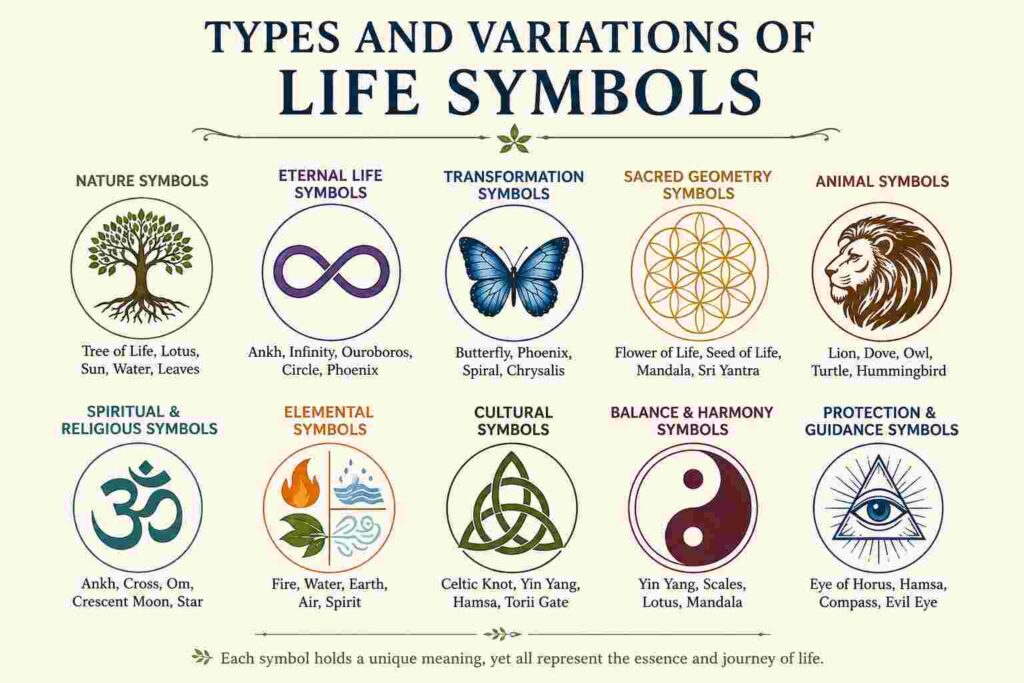
Types and Variations of Life Symbols
1. The Tree of Life
Appears as Yggdrasil (Norse), the Kabbalistic Tree (Jewish mysticism), Bodhi Tree (Buddhism), and Celtic Tree of Life, among others.
2. The Ankh
Originated in ancient Egypt but influenced Coptic Christian crosses and modern tattoo culture worldwide.
3. The Infinity Symbol
From John Wallis’s 1655 mathematical notation to modern wedding ring engravings and memorial tattoos.
4. The Spiral
Found in Celtic art, Maori tattoo (koru), Native American rock art, and the golden ratio in nature.
5. The Lotus Flower
Sacred in Hindu, Buddhist, and ancient Egyptian traditions — each slightly different in symbolic emphasis.
6. The Phoenix
Appears in Greek mythology, Chinese legend (Fenghuang), Egyptian Bennu bird, and Christian resurrection symbolism.
7. The Circle
From the Zen enso (empty brush circle) to the Celtic wheel to the mandala — the circle is the most universal life symbol of all.
Life Symbols Across Cultures
Ancient Egypt
Egypt’s obsession with eternal life produced the richest vocabulary of life symbols in the ancient world: the Ankh, the Djed Pillar, the Eye of Horus, the Scarab, and the Bennu bird (prototype of the Phoenix) all emerged from the Nile Delta.
Celtic Culture
The Celts expressed life symbolism through interlocking knotwork that has no beginning or end, spirals representing growth and the cosmos, and the Tree of Life connecting the three worlds of existence.
Eastern Cultures
In Hindu and Buddhist traditions, the lotus flower and the Om symbol dominate life symbolism. Chinese culture contributed the dragon (vitality, power), bamboo (resilience), and the Yin-Yang (the balance that sustains life).
Greek Mythology
The Greeks expressed life symbolism through narrative and nature: the olive branch (peace and plenty), the laurel wreath (victory and achievement), and the caduceus (healing and balance) all carry deep life significance.
Native American Culture
Native American life symbolism is deeply tied to the natural world: the eagle (spiritual elevation), the turtle (earth and longevity), the bear (strength and healing), and complex labyrinth designs representing life’s journey.
Life Symbols in Art, Movies and Pop Culture
Movies
- The Lion King — The Circle of Life becomes a visual and musical centerpiece
- The Lord of the Rings — The White Tree of Gondor as a symbol of hope and the survival of life
- Black Panther — Vibranium heart-shaped herb as a symbol of life force and power
Paintings
- Gustav Klimt’s The Tree of Life (1909) is one of the most recognized paintings built entirely around life symbolism
- Frida Kahlo frequently used butterflies, flowers, and roots as life symbols throughout her self-portraits
Tattoos
Life symbols dominate tattoo culture. The most requested designs include:
- Tree of Life (representing family and growth)
- Phoenix (representing survival and resilience)
- Lotus (representing inner peace)
- Semicolon (representing mental health survival)
- Butterfly (representing personal transformation)
Fashion and Jewelry
The Ankh experienced a major revival in 1990s hip-hop culture and again in contemporary jewelry. Infinity symbol necklaces became one of the bestselling jewelry designs of the 2000s and remain popular today.
Spiritual and Dream Meaning of Life Symbols
When life symbols appear in dreams or meditation, they often carry personal messages:
- Dreaming of a Tree of Life → Personal growth underway; examine your roots and your goals
- Dreaming of a Phoenix → You are in or approaching a period of profound transformation
- Dreaming of a Lotus → Spiritual awakening; clarity emerging from difficult circumstances
- Dreaming of an Infinity Symbol → A relationship or situation that feels boundless; examine whether that feels freeing or constraining
Spiritual practitioners across traditions treat these symbols as inner guideposts — messages from the deeper self about where life is heading.
Positive and Negative Meaning of Life Symbols
Positive Meaning
- Growth and renewal
- Hope in difficult times
- Connection to ancestors and heritage
- Spiritual protection and guidance
- Love and continuity
Negative Meaning
- Some life symbols also carry shadow meanings: the Phoenix represents destruction before rebirth
- The Ouroboros can suggest stagnation — going in circles — as well as renewal
- The Skull, while often a life symbol in some cultures, can represent mortality’s pressure on the living
- Water, symbol of life, also represents overwhelming emotion or loss of control in certain contexts
Life is complex. The best life symbols honor that complexity.
Why Humans Are Attracted to Life Symbols
Psychologists and anthropologists offer several explanations:
- Pattern recognition : The human brain is wired to find meaning in visual patterns
- Mortality awareness : We are the only species that knows it will die, which makes symbols of eternal life deeply comforting
- Community and belonging : Shared symbols create tribal bonds and cultural identity
- Emotional processing : Symbols give form to feelings that words fail to capture
- Legacy and memory : Symbols carry meaning across generations without requiring language
As Carl Jung observed, symbols reach parts of the psyche that rational thought cannot access. They speak directly to the emotional and unconscious mind.
FAQs About Life Symbols
What is the most powerful symbol of life?
The Tree of Life is widely considered the most powerful, appearing across virtually every culture in history. The Ankh earns the title for the oldest dedicated life symbol.
What symbol represents eternal life?
The Ankh, the Ouroboros, and the Infinity symbol (∞) are the three most recognized symbols of eternal life across world cultures.
Why do people use life symbols in tattoos?
People tattoo life symbols to carry permanent reminders of their values, survival stories, and beliefs — turning their bodies into living declarations of what matters most to them.
What symbol represents rebirth?
The Phoenix is the definitive symbol of rebirth, followed by the Butterfly (metamorphosis) and the Lotus (rising from mud to bloom).
Are life symbols universal?
Many overlap across cultures — the Tree of Life, the Circle, and the Spiral appear on every continent. However, some symbols are culture-specific and carry meanings that may differ or even conflict between traditions.
What does the circle symbolize in life?
The circle represents eternity, unity, and the endless cycle of life — it has no beginning and no end, making it the purest geometric expression of ongoing existence.
Conclusion
Life symbols are more than ancient art or spiritual decoration. They are the human race’s attempt to look directly at the mystery of existence and say: this is what it means to be alive.
From the Egyptian Ankh carved 5,000 years ago to a semicolon tattoo chosen by a survivor today, these symbols do the same work across every century — they give shape and meaning to something that resists easy definition.
Whatever symbol resonates most deeply with you is worth exploring. The meaning you bring to it is just as important as the meaning it already carries.