War symbols, has shaped human civilization for thousands of years. Long before written language existed, people used powerful symbols to communicate danger, rally armies, honor the fallen, and mark the line between peace and conflict. These symbols — whether weapons, animals, colors, mythological figures, or everyday objects — carry deep emotional and cultural weight that still resonates today.
Throughout history, no battle was fought in a vacuum of pure violence. Every army marched behind ideas, and symbols were the language of those ideas. A single emblem on a shield could tell an enemy who they were facing. A flag planted in the earth claimed territory for a nation. A war drum’s rhythm told soldiers it was time to move. These weren’t just visual decorations — they were psychological tools, spiritual anchors, and cultural identifiers.
This comprehensive guide explores the most significant things that represent war across history, mythology, religion, and modern culture — and explains what each one truly means.
What Are War Symbols?
War symbols are visual signs, objects, animals, colors, or emblems that represent conflict, military power, sacrifice, bravery, or victory. They appear across ancient monuments, military insignias, tattoos, literature, film, and memorial ceremonies worldwide.
These symbols do more than decorate armor or flags — they communicate complex ideas instantly. A skull signals danger and mortality. A red poppy honors the fallen. An eagle projects dominance and strength. Across every civilization, war symbolism has served as both a battle tool and a living cultural record.
War symbols gain their power through repetition and emotional association. Every time a culture uses a symbol in the context of battle — on armor, in ceremony, in art, in stories — that symbol absorbs more meaning. Over centuries, these images become inseparable from the emotions they represent: courage, grief, pride, and loss.
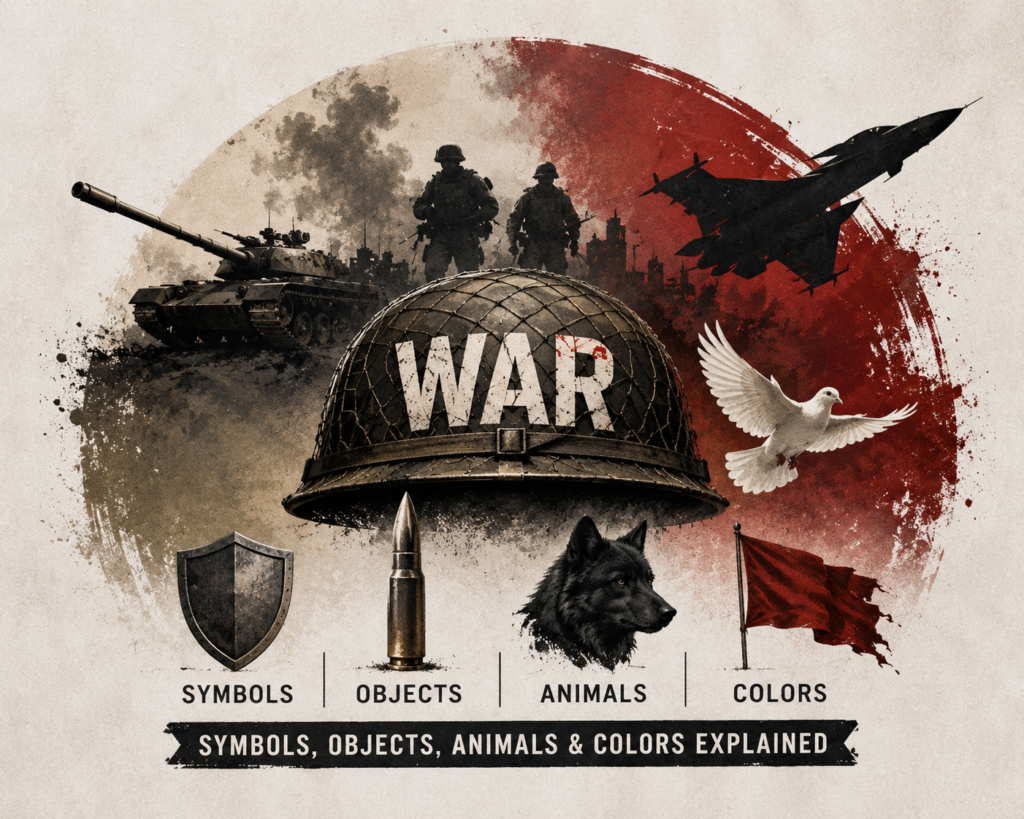
Weapons and Objects That Represent War
Weapons are the most obvious physical representations of war. But over time, each weapon transcended its practical purpose and took on layers of symbolic meaning that extended far beyond the battlefield.
1. The Sword
The sword is one of the oldest and most universal symbols of war. In medieval Europe, knights carried swords as signs of loyalty and bravery. In Japan, the samurai sword — the katana — represented not only physical combat skill but spiritual discipline, honor, and devotion. Samurai viewed the sword as an extension of the soul. Many ancient warriors even named their swords, treating them as sacred companions rather than mere tools.
Beyond the battlefield, swords appear in religious art, courtroom imagery, and royal ceremonies as symbols of justice, authority, and divine power. The phrase “the sword of justice” remains in everyday language today. A crossed pair of swords — one of the most widely recognized war symbols — signifies active conflict or military engagement, commonly used on military maps, regimental insignias, and gravestones of fallen soldiers.
In heraldry, the sword’s position mattered: a sword pointing upward represented readiness for battle, while a downward-pointing sword could mean surrender or the end of conflict.
2. The Shield
Where the sword represents offense, the shield represents defense, protection, and resilience. Ancient Greek hoplites decorated their shields with intricate imagery to intimidate enemies in the tight formations of the phalanx. Roman soldiers carried the scutum — a large rectangular shield — as both physical armor and a symbol of the legion’s collective strength. African tribal warriors painted meaningful spiritual patterns on shields to invite divine protection in battle.
Perhaps the most famous shield in all of war literature is the Shield of Achilles. Described in vivid detail in Book 18 of Homer’s Iliad, it was forged by the god Hephaestus and decorated with scenes from everyday life alongside images of warfare — making it a reflection of the entire human experience, not just combat. Because of this, the shield became a symbol of Achilles’ status as the dominant warrior in the Trojan War.
Shields also communicated identity. In medieval Europe, coats of arms painted onto shields allowed soldiers to recognize allies and enemies in the chaos of battle. The shield, then, is not just protection — it is identity, heritage, and belonging.
Read More: http://symbolsmeans.com/
3. The Arrow
In many ancient civilizations, the arrow was the primary ranged weapon and a deeply symbolic object. In Native American culture, arrows were both life-sustaining tools for hunting and weapons of war. The direction of an arrow held specific meaning: an arrow pointed left warded off evil, an arrow pointed right represented protection, and a single downward arrow signified peace. Most powerfully, two horizontal arrows pointing in opposite directions symbolized war — mimicking the visual of arrows flying between opposing warriors.
This dual symbolism reminds us that many war symbols also carry the possibility of resolution. The same object that represented war could, by a change in position, represent peace.
In Greek and Roman mythology, arrows were the weapons of the gods themselves — Apollo shot arrows of plague, while Eros used them to spark love. This divine connection elevated the arrow from mere weapon to cosmic instrument of fate.
4. The Skull
The skull is one of the starkest war symbols across every culture, representing death, mortality, danger, and the ultimate cost of battle. Military groups throughout history adopted the skull on banners and uniforms to project fearlessness and to remind both their enemies and themselves that death was an ever-present companion.
Pirates famously flew skull-and-crossbones flags to terrorize merchant ships without firing a shot. Elite military units, from Prussian hussars to World War II SS divisions, used skull insignia to communicate that their members operated beyond normal boundaries of fear. Even today, modern special operations units and motorcycle clubs associated with military veterans use skull imagery to signify brotherhood in the face of death.
In fine art, the skull as a war symbol reaches its apex in Vasily Vereshchagin’s painting The Apotheosis of War (1871) — a haunting image of a pyramid of human skulls on a barren landscape, crows circling overhead. Vereshchagin, a war correspondent and painter who witnessed real combat, intended the image as a direct anti-war statement. The frame of the original painting bears an inscription: “Dedicated to all great conquerors, past, present, and future.” The skull here becomes not a symbol of warrior pride, but of war’s ultimate futility.
5. The Battle Flag
Flags are not merely fabric — in wartime, they become the physical embodiment of an army, a nation, or a cause worth dying for. A single flag waving on a battlefield could inspire thousands of exhausted soldiers to rise and fight on. Losing a regiment’s flag in battle was considered a catastrophic disgrace. Capturing an enemy’s flag was a prize of war.
The Roman vexillum was one of the earliest true military flags — a rectangular cloth hung from a horizontal crossbar — and gave us the word “vexillology” (the study of flags). Viking longships flew distinctive banners to communicate clan identity. Medieval crusaders carried banners emblazoned with crosses into the Holy Land. In the American Civil War, the capture or protection of the regimental colors was a defining moment of countless engagements.
Today, military flags and national emblems during conflict still carry enormous symbolic and emotional power. The raising of a flag over Iwo Jima became one of the most iconic photographs in American history — not because of what it depicted tactically, but because of what it symbolized emotionally.
6. The Helmet and Armor
Military armor, particularly the helmet, has been a powerful symbol of the warrior identity across cultures. Greek hoplite helmets with their horsehair crests made soldiers appear taller and more imposing. Viking helmets have been mythologized into horned symbols of ferocity (though the horns were largely fictional). Japanese samurai helmets — kabuto — were elaborate works of art, featuring crests that identified the warrior and often represented animals or spiritual forces.
In the modern era, the military helmet remains a universal symbol of the soldier. An empty helmet placed on a rifle — the battlefield cross — is one of the most solemn war symbols in contemporary military tradition, used to mark a fallen comrade during memorial services.
Animals That Represent War
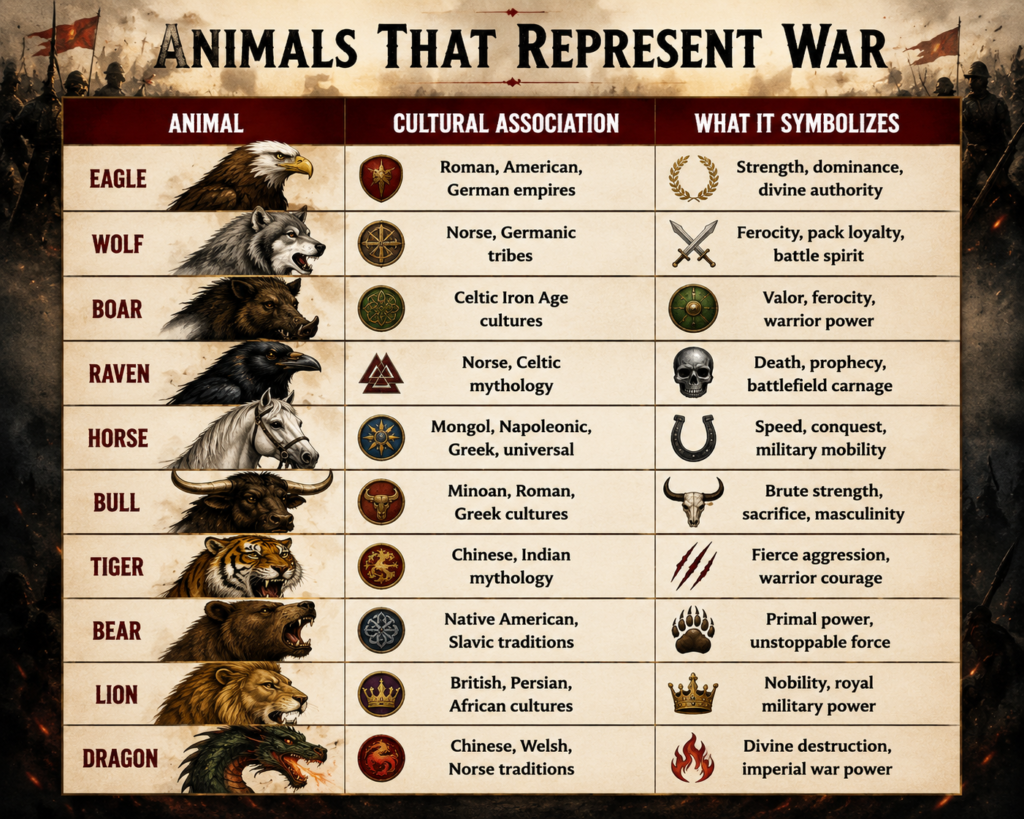
Throughout history, certain animals have been so closely associated with the qualities needed in war — strength, ferocity, speed, cunning — that they became living symbols of military power.
| Animal | Cultural Association | What It Symbolizes |
|---|---|---|
| Eagle | Roman, American, German empires | Strength, dominance, divine authority |
| Wolf | Norse, Germanic tribes | Ferocity, pack loyalty, battle spirit |
| Boar | Celtic Iron Age cultures | Valor, ferocity, warrior power |
| Raven | Norse, Celtic mythology | Death, prophecy, battlefield carnage |
| Horse | Mongol, Napoleonic, Greek, universal | Speed, conquest, military mobility |
| Bull | Minoan, Roman, Greek cultures | Brute strength, sacrifice, masculinity |
| Tiger | Chinese, Indian mythology | Fierce aggression, warrior courage |
| Bear | Native American, Slavic traditions | Primal power, unstoppable force |
| Lion | British, Persian, African cultures | Nobility, royal military power |
| Dragon | Chinese, Welsh, Norse traditions | Divine destruction, imperial war power |
The Eagle
The eagle is perhaps the single most iconic animal associated with war across human history. Roman legions marched behind golden eagle standards called aquilae — losing the eagle was one of the greatest disgraces a legion could suffer. The United States adopted the bald eagle as its national symbol, embedding it in military seals and insignia. The German Empire, the Austro-Hungarian Empire, and Nazi Germany all used the eagle on military emblems. The eagle’s ability to soar above all other creatures made it a natural metaphor for imperial power and divine oversight of the battlefield.
The Boar
In Celtic Iron Age culture, the boar was the most direct animal symbol of war. The Celts admired and respected the boar’s ferocity — particularly its aggressive defense when cornered, charging headlong at danger rather than fleeing. Celtic warriors placed boar imagery on their helmets, shields, and war trumpets called carnyxes, whose bells were shaped like snarling boar heads. When blown before battle, the carnyx produced a terrifying shriek meant to psychologically overwhelm the enemy.
The boar also had spiritual significance, linked to Celtic warrior deities. Consuming boar meat was believed to bestow strength and courage, making it a ritual food served before battle and to honored guests.
The Raven
Ravens carried some of the darkest war symbolism in the ancient world. As scavengers that descended on battlefields to feed on the dead, they became living omens of carnage. In Norse mythology, the god Odin — the Allfather and god of war — kept two ravens named Huginn (Thought) and Muninn (Memory) who flew across the world and reported back to him. Viking warriors who died in battle were said to become part of Odin’s army in Valhalla.
In Celtic mythology, the goddesses of war — the Morrigna — could transform into ravens, hovering over battlefields and terrifying armies into defeat. The Irish phrase Badbh Catha literally means “Battle Crow.” The raven’s intelligence, its black plumage, and its association with death made it the perfect embodiment of war’s darkest dimensions.
The Horse
From the Mongol conquests to the Napoleonic campaigns, the horse was militarily indispensable for over three thousand years. It symbolized speed, strategic mobility, and the unstoppable momentum of a charging cavalry. The image of the mounted warrior — knight, samurai, or Mongol horseman — remains one of the most powerful visual metaphors for military power in human history.
In Greek mythology, the Trojan Horse stands as one of the greatest war symbols ever conceived. Not a symbol of brute force, but of cunning, patience, and deception — qualities that proved more decisive than strength alone. The story has given the English language an enduring metaphor for hidden threats and strategic misdirection.
Colors That Represent War
Colors communicate on a primal level, bypassing conscious thought to trigger emotional responses. Military cultures across history understood this intuitively.
- Red — The color most universally linked to war. It represents blood, sacrifice, aggression, and danger. Red banners have been raised by armies from ancient Rome to revolutionary France to signal battle readiness. Red is the color of Mars, the Roman god of war. Even today, red in military contexts triggers an immediate psychological response of alertness and threat.
- Black — Represents death, authority, and intimidation. Black uniforms have been adopted by elite military units across history — from the Prussian Death’s Head Hussars to the Nazi SS to modern tactical law enforcement — specifically because of the psychological weight of the color. Black flags have long signaled “no quarter given” — a declaration of total war.
- Crimson and Scarlet — Used in military dress uniforms to project ceremonial honor while acknowledging the blood cost of service. The British Redcoats made scarlet one of the most recognizable military colors of the 18th and 19th centuries.
- Gold — Associated with imperial military power, divine authority, and the highest ranks of military command. Eagle standards, royal crowns, and general’s insignia are consistently rendered in gold.
- Olive Drab and Camouflage Green — Modern colors of warfare representing stealth, concealment, and the grim practical realities of 20th and 21st-century combat.
Mythological and Cultural Symbols of War
Every major civilization developed mythological symbols that gave war a cosmic dimension — connecting earthly conflict to divine order, spiritual struggle, and destiny.
The Vajra (Hindu and Buddhist)
The vajra is a five-pronged ritual weapon in Hindu and Buddhist traditions, with a name meaning both “diamond” and “thunder.” According to the ancient Vedic texts, it was forged for Indra, the King of Heaven, as the ultimate weapon against sinners and ignorance. The vajra represents the hardness of a diamond — indestructible and cutting through all illusion — and the force of lightning, which strikes without warning and cannot be deflected.
In Buddhist practice, the vajra is used ritually alongside a bell, the two together representing the male and female principles of existence. The vajra’s dual role — both destroyer and spiritual tool — reflects a broader truth about many war symbols: they carry meanings of destruction and transformation simultaneously. Tibetan monks still use the vajra today.
Mjolnir — Thor’s Hammer (Norse)
Thor’s hammer Mjolnir is one of the most powerful and beloved war symbols in Norse mythology. Used to defeat giants, serpents, and the forces of chaos, Mjolnir represents raw warrior power, the protection of civilization, and divine strength. The hammer always returned to Thor’s hand after being thrown — a symbol of unstoppable, inevitable force.
Viking warriors wore Mjolnir pendants into battle as protective amulets, trusting that the thunder god’s weapon would guard them. Today, Mjolnir remains a popular symbol in Viking-revival culture, military tattoos, and Scandinavian identity — testament to the enduring power of a well-crafted war symbol.
The Akoben (West African Adinkra)
Created by the Bono people of Ghana, the Akoben is a traditional war horn symbol from the Adinkra visual language of the Akan people. In practical terms, the war horn was blown to warn communities of incoming attack and to summon warriors to the battlefield. As a symbol, the Akoben represents vigilance, alertness, patriotism, and loyalty.
The Akoben carries an important message that extends beyond warfare: a community that is always vigilant and prepared will be one that rarely needs to fight. It is as much a symbol of wise governance and collective responsibility as it is of military readiness.
The Valknut (Norse)
The Valknut — three interlocking triangles — is a Norse symbol deeply associated with Odin and fallen warriors. The name likely derives from Old Norse words meaning “knot of the slain.” It appears on ancient runestones and burial artifacts, typically in contexts related to death in battle and the transition of warriors to Valhalla. For Norse warriors, death in battle was not a tragedy but an honor — and the Valknut symbolized that sacred passage.
Two Arrows (Native American)
Among many Native American tribes, the image of two arrows pointing in opposite directions was a direct and immediate symbol of war — mimicking the visual of arrows flying between opposing warriors. This symbol appeared in tribal art, ceremonial objects, war paint traditions, and treaty negotiations across many nations. Its simplicity made it universally understood across language barriers between tribes.
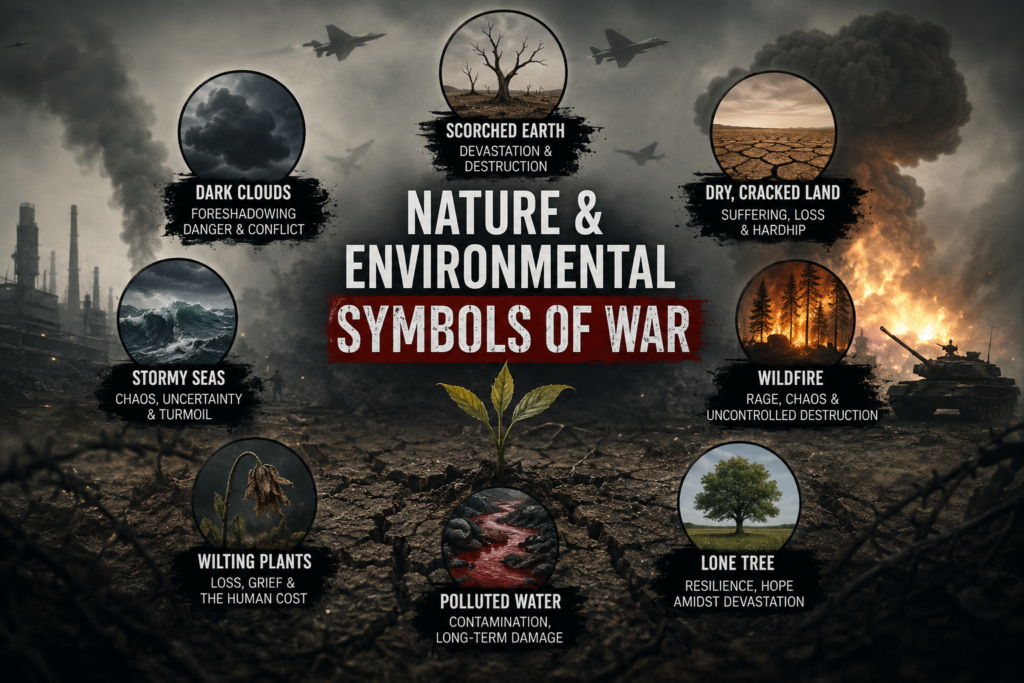
Nature and Environmental Symbols of War
Beyond objects and animals, cultures found war symbolism in the natural world itself — in weather, fire, and the behavior of birds and beasts.
- Fire — Perhaps the most primal symbol of war’s destructive power. Fire consumes everything in its path, leaves ash in its wake, and yet enables new growth. War, like fire, destroys and transforms. Ancient commanders used fire signals to communicate across distances and to signal battle commencement. The Olympic torch, carried from Greece to the site of each modern Games, is a descendant of ancient torch relay systems used in warfare.
- Thunder and Lightning — Linked to the war gods of nearly every ancient culture: Thor in Norse tradition, Zeus in Greek, Indra in Hindu, Jupiter in Roman. The sudden, overwhelming, unstoppable nature of lightning made it the perfect metaphor for the ideal military strike — decisive, devastating, impossible to defend against.
- Smoke — In many warrior traditions, smoke on the horizon signaled battle and destruction. Signal fires and smoke columns were critical communication tools across ancient battlefields. Smoke also features prominently in post-battle art as a visual shorthand for the aftermath of conflict.
- Crows and Vultures — Scavenger birds that followed armies and descended on fallen bodies became deeply associated with death and the battlefield across cultures from Europe to the Americas to Asia. Their arrival signaled the end of fighting and the beginning of grief.
- Storms — Storms were historically interpreted as divine communications — warnings from the gods about coming conflict, or blessings upon an army’s cause. Many famous battles have been preceded or accompanied by dramatic weather that later became part of their mythology.
The Red Poppy: The Modern World’s Most Powerful War Symbol
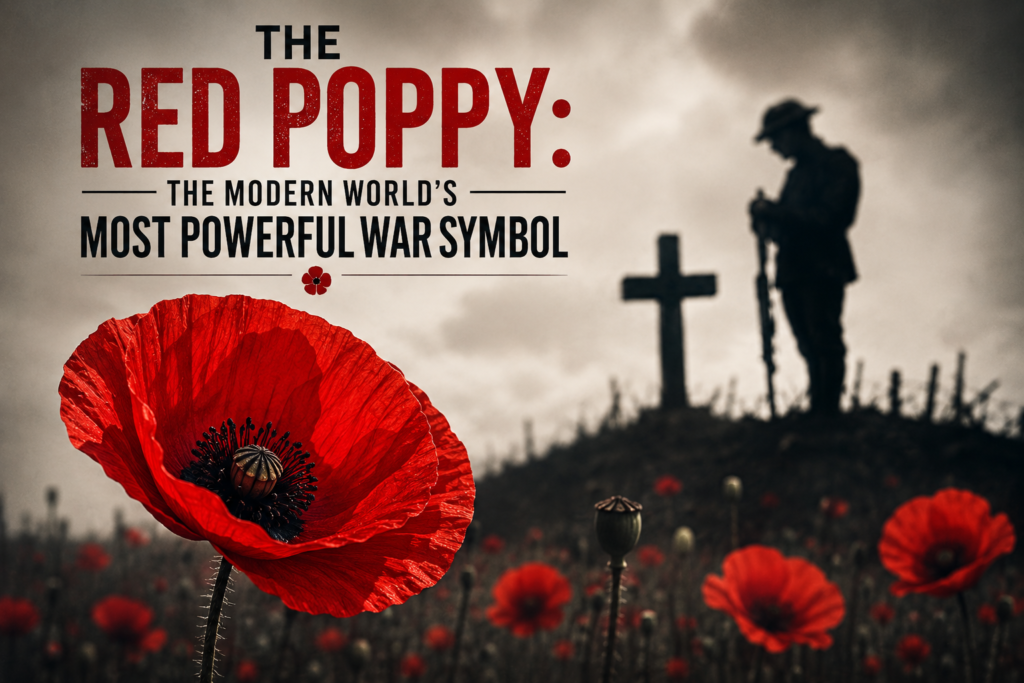
Few war symbols carry as much raw emotional weight as the red poppy. Its story begins in the aftermath of some of World War I’s most devastating battles in Flanders Fields, Belgium. The shelling and destruction of the soil paradoxically released dormant poppy seeds, and the fields where hundreds of thousands of soldiers had died burst into brilliant red blooms the following spring.
Lieutenant Colonel John McCrae, a Canadian physician and soldier, captured this image in his 1915 poem In Flanders Fields: the poppies blowing between the crosses of fallen soldiers. The image immediately resonated with a war-weary world, and the red poppy was adopted as the official symbol of remembrance for Commonwealth war dead. Worn every November in the UK, Canada, Australia, and beyond, the poppy connects modern civilians to the human cost of war in an immediate, personal way.
Today, different colored poppies carry distinct meanings, reflecting the evolution of war remembrance:
- Red poppy — Honors military personnel killed in armed conflict
- White poppy — Worn by pacifists, representing opposition to all war and remembrance of all victims including civilians
- Purple poppy — Remembers the animals — horses, dogs, carrier pigeons — that served and died alongside human soldiers
- Black poppy — Honors the contributions of Black, African, and Caribbean communities often overlooked in mainstream war remembrance
War Symbols in Literature and Art
Literature and visual art have long used war symbolism to explore the human experience of conflict in ways that raw historical reporting cannot.
In Homer’s Iliad, nearly every major character is defined by their war symbol — Achilles by his divine armor, Hector by his plumed helmet, Odysseus by his cunning and the bow no other man could draw. These objects are not just weapons; they are character identities.
Shakespeare used war symbols extensively — the crown as a symbol of power worth killing for, the sword as justice corrupted into murder, the armor as the thin shell between a man and his death. In Henry V, the St. George’s Cross flag became a symbol of English national identity forged in the heat of battle.
In modern literature, war symbols adapt to new contexts. The mockingjay pin in The Hunger Games follows the ancient pattern of a rebel army adopting a symbol to unite resistance and terrify an oppressor. The Darksaber in Star Wars mythology carries all the symbolic weight of Excalibur — whoever holds the weapon holds the right to lead.
Quick Reference: Things That Represent War
| Category | Symbol | Core Meaning |
|---|---|---|
| Weapon | Sword | Honor, justice, warrior spirit |
| Weapon | Arrow (pair) | Active conflict, opposing forces |
| Weapon | Spear | Divine warfare, martial authority |
| Object | Skull | Death, mortality, fearlessness |
| Object | Battle flag | National identity, army unity |
| Object | Helmet | Warrior identity, protection |
| Flower | Red poppy | Sacrifice, remembrance |
| Animal | Eagle | Power, dominance, divine authority |
| Animal | Raven | Death, battle omens, prophecy |
| Animal | Boar | Ferocity, warrior valor |
| Animal | Horse | Speed, conquest, military mobility |
| Animal | Wolf | Pack loyalty, ferocity |
| Color | Red | Blood, aggression, sacrifice |
| Color | Black | Death, intimidation, elite power |
| Mythology | Vajra | Divine warfare, unstoppable force |
| Mythology | Mjolnir | Warrior protection, raw strength |
| Mythology | Valknut | Fallen warriors, Odin’s domain |
| Cultural | Akoben | Vigilance, patriotism, loyalty |
| Nature | Fire | Destruction and rebirth through conflict |
| Nature | Thunder/Lightning | Divine wrath, overwhelming force |
Why War Symbols Still Matter Today
In an age of satellite warfare and digital conflict, it might seem that ancient symbols have lost their relevance. They haven’t. If anything, the psychological and cultural functions of war symbols have become more important, not less, because modern warfare is increasingly a battle of narratives and identities as much as a physical contest.
Military organizations still invest heavily in the design of insignias, unit patches, and regimental colors because these symbols build the cohesion and identity that make effective fighting forces. Nations go to war carrying their flags and anthems because those symbols communicate to both allies and enemies what is at stake. Resistance movements throughout history — from the French Resistance to the Arab Spring — adopted powerful symbols precisely because visual identity creates solidarity.
War symbols also serve a vital function after conflict ends. Memorials, monuments, and remembrance ceremonies use symbols — the eternal flame, the poppy, the empty boots — to ensure that the human cost of war is never abstracted into mere statistics. These symbols bridge the gap between those who fought and those who did not, preserving the emotional truth of conflict across generations.
Conclusion
The things that represent war tell us far more than the history of battles. They reveal how cultures across time and geography have understood courage, sacrifice, justice, identity, and survival. From the crossed swords of medieval knights to the red poppies of Flanders Fields, from the eagle standards of Rome to the ravens of Celtic mythology, from the Akoben war horn of Ghana to the Vajra of the Vedic gods — every war symbol is a compressed story of humanity’s deepest struggles, both external and internal.
These symbols did not emerge arbitrarily. Each one was earned — through blood, ceremony, repetition, and meaning-making — by communities trying to make sense of the most terrifying and transformative experience in human life. Understanding these symbols helps us connect with history, appreciate cultural diversity, and reflect honestly on what conflict truly costs.
Whether you encounter them in a museum, on a war memorial, in the pages of a novel, or on the arm of a veteran, war symbols remind us of a simple, profound truth: behind every battle were real people who needed something to believe in. These symbols were — and still are — that something.
Frequently Asked Questions (FAQs)
What is the most universal symbol of war?
The sword is widely considered the most universal war symbol, appearing across nearly every culture and era as a sign of military power, honor, and the warrior spirit.
What color represents war?
Red is the color most universally associated with war, symbolizing blood, sacrifice, and aggression — used on battle flags and military uniforms across civilizations for thousands of years.
What animal symbolizes war the most?
The eagle is the most widely used animal symbol of war, representing strength, dominance, and divine authority in Roman, American, Germanic, and many other cultures throughout history.
What does the red poppy represent in war?
The red poppy symbolizes remembrance and sacrifice for soldiers killed in battle, especially those who died in World War I, where poppies grew across the devastated battlefields of Flanders, Belgium.
What is the difference between a war symbol and a peace symbol?
War symbols — like crossed swords, skulls, or battle flags — represent conflict, power, and military strength. Peace symbols, like the white flag or olive branch, signal the desire to end hostilities and restore harmony.
Do war symbols always represent violence?
No. Many war symbols also carry meanings of bravery, protection, resilience, and sacrifice. The shield, for example, is as much about defense and survival as it is about conflict.
What are some mythological symbols of war?
Notable mythological war symbols include Thor’s hammer (Mjolnir) from Norse mythology, the vajra from Hindu and Buddhist traditions, the spear of Ares from Greek mythology, the Valknut associated with Odin, and the raven connected to Norse and Celtic war goddesses.
Why do modern militaries still use ancient symbols?
Ancient symbols create psychological cohesion, unit identity, and emotional commitment. A regimental crest or unit patch connects soldiers to a tradition of service that extends beyond any individual, building the shared identity that makes effective military units possible.
What natural elements symbolize war?
Fire, thunder, lightning, and storms are the most common natural symbols of war, linked to war gods across Hindu, Norse, Greek, and Roman mythology. Ravens and vultures are also strongly associated with battle and its aftermath across many cultures.
What is the Akoben symbol?
The Akoben is a West African Adinkra war horn symbol from the Akan people of Ghana. It represents vigilance, patriotism, alertness, and loyalty — the qualities a community needs to defend itself. It was historically blown to warn of attack and to call warriors to battle.