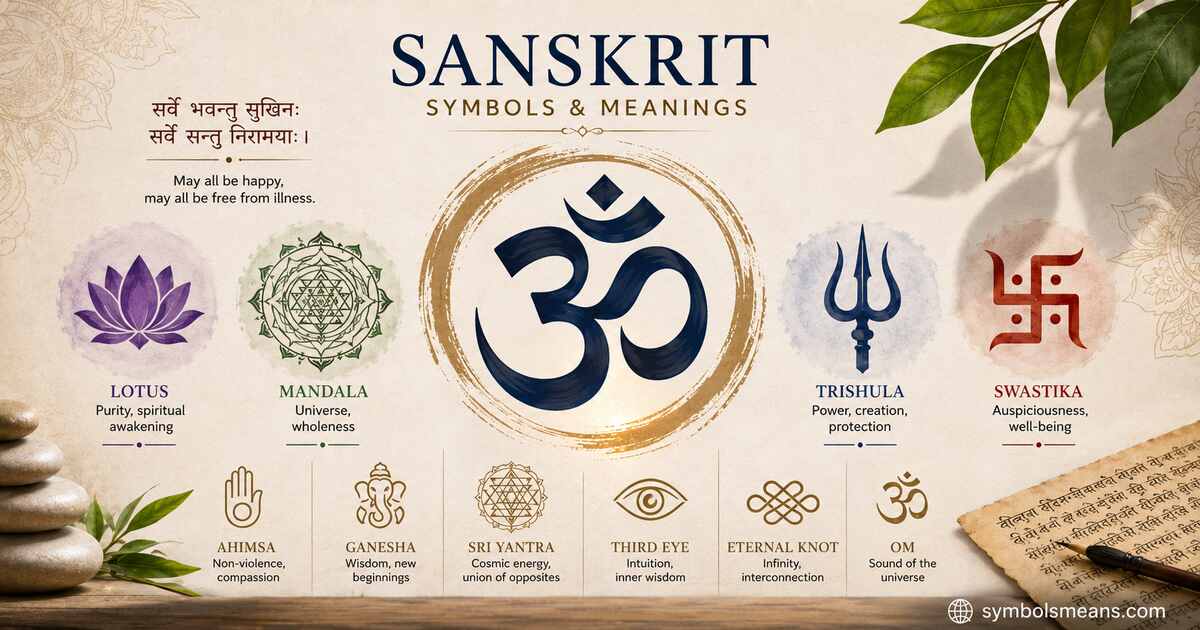
From the sound of “Om” opening a yoga class to a lotus tattooed on someone’s wrist, Sanskrit symbols have quietly worked their way into everyday life around the world. Each one carries thousands of years of spiritual meaning behind its simple shape. This guide breaks down the most important Sanskrit symbols, their true origins, and why they continue to resonate so deeply today.
What Are Sanskrit Symbols?
Sanskrit symbols are the sacred images, syllables, and geometric designs rooted in Sanskrit language, Hindu philosophy, and Vedic tradition. Some, like Om, represent sound itself given visual form. Others, like the lotus or mandala, represent spiritual concepts too complex to fully capture in words.
These symbols aren’t just religious decoration. They’re used in meditation, ritual, art, and architecture, functioning as tools that help the mind focus on ideas like consciousness, balance, and enlightenment.
Ancient Sanskrit Symbols And Their Spiritual Meanings
Sanskrit Symbols And Meanings
At their core, most Sanskrit symbols represent a handful of central ideas: the nature of consciousness, the journey toward enlightenment, and the balance between spiritual and material life.
Buddhist Sanskrit Symbols And Meanings
Many symbols originally rooted in Hindu tradition, including Om, the lotus, and the mandala, were later adopted and reinterpreted within Buddhism, especially as the religion spread into Tibet and East Asia.
Ancient Sanskrit Symbols
Some of the oldest Sanskrit symbols date back thousands of years, with the swastika appearing in Indus Valley artifacts as early as 2500 BCE, long before it became one of the most misunderstood symbols in modern history.
Sanskrit Symbol For Life
The lotus is often considered the clearest Sanskrit symbol for life itself, representing growth, resilience, and the ability to remain pure even while rooted in difficult circumstances.
Sanskrit Symbols For Breathe
In yogic tradition, the syllable “Ham” and certain pranayama-related symbols are associated with breath, representing the life force, or prana, that breathing is believed to circulate through the body.
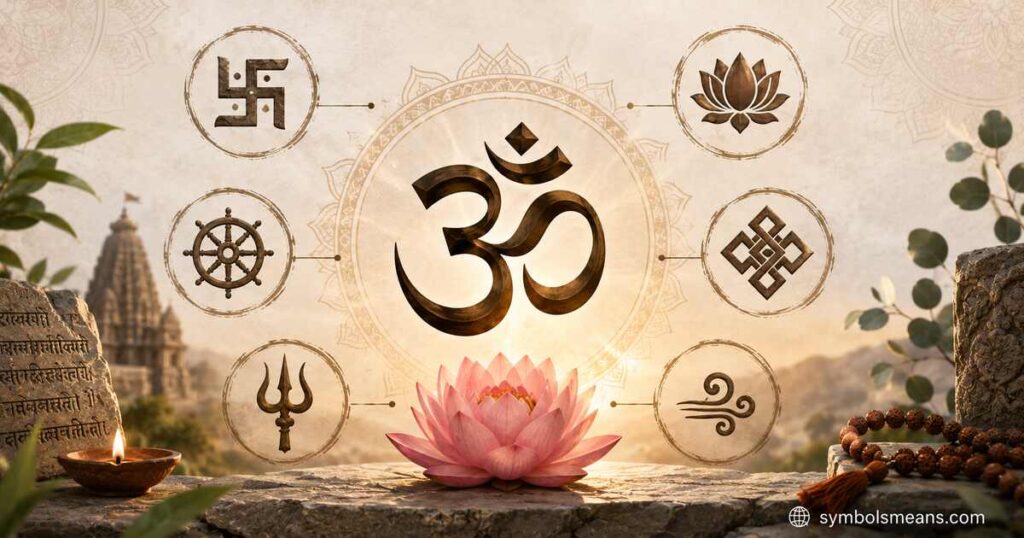
Popular Sanskrit Symbols In Tattoos And Modern Design
Sanskrit Symbols Tattoos
Om, the lotus, and the unalome are among the most requested Sanskrit-inspired tattoo designs, chosen for both their visual simplicity and their deep spiritual meaning.
Sanskrit Symbols And Meanings Tattoos
Before choosing one of these tattoos, it helps to understand the specific meaning behind the design, since many carry religious weight beyond their aesthetic appeal.
Spiritual Sanskrit Symbols
Beyond Om and the lotus, spiritual practitioners often use yantras, geometric diagrams believed to hold and direct spiritual energy during meditation.
Sanskrit Symbols Text
Sanskrit is written in the Devanagari script, and many people use short Devanagari phrases or single syllables as text-based spiritual symbols in tattoos, art, and jewelry.
Symbols Of Sanskrit
Collectively, these symbols represent the idea that sound, form, and spirit are deeply connected in Sanskrit philosophy, a concept known as Shabda Brahman.
Sanskrit Symbols Meaning
Each symbol typically operates on more than one level, carrying both a literal meaning and a deeper philosophical concept tied to consciousness or the divine.
Read More : 71+ Best French Symbols That Define Culture, History and Identity in 2026
Sanskrit Symbol For Balance
The Ardhanarishvara concept, representing the union of masculine and feminine energy, along with certain yantra designs, is closely tied to the idea of spiritual balance.
Breathe Sanskrit Symbol
Modern spiritual design often pairs the word “breathe” with Sanskrit-inspired imagery like a simple lotus outline, representing calm and presence in the current moment.
Deep Symbolic Meaning
Sanskrit symbols work on three connected levels. Spiritually, they represent a bridge between the human and the divine, tools used to focus the mind during prayer and meditation. Psychologically, symbols like the lotus or mandala give the mind a visual anchor for abstract ideas like growth or wholeness, making complex philosophical concepts easier to sit with. Culturally, these symbols have traveled far beyond their origins, shaping global yoga culture, wellness branding, and spiritual art far outside South Asia.
Types / Variations of Sanskrit Symbols
Om Symbol
Considered the most sacred sound and symbol in Hindu tradition, Om represents the vibration of the universe itself, along with the unity of mind, body, and spirit. It’s chanted at the start of prayers, mantras, and yoga sessions across Hinduism, Buddhism, and Jainism.
Lotus Symbol
The lotus grows from muddy water yet blooms untouched by the mud around it, making it a natural symbol for purity, spiritual growth, and enlightenment achieved despite difficult circumstances.
Swastika Symbol
One of the oldest known symbols in human history, the swastika’s name comes from the Sanskrit “su” (good) and “asti” (to exist), meaning well-being and good fortune. In its original and continuing use across Hindu, Buddhist, and Jain tradition, it appears on temple walls, wedding invitations, and ceremonial objects as a mark of auspiciousness — a meaning that predates its 20th-century political misuse by thousands of years.
Chakra Symbols
Each of the seven chakras is represented by its own lotus-based symbol, paired with a specific Sanskrit seed syllable, or bija mantra, believed to activate that particular center of energy in the body.
Mandala
A circular, geometric design representing wholeness and the universe itself, mandalas are used as meditation tools to help the mind move from scattered thoughts toward a sense of unity.
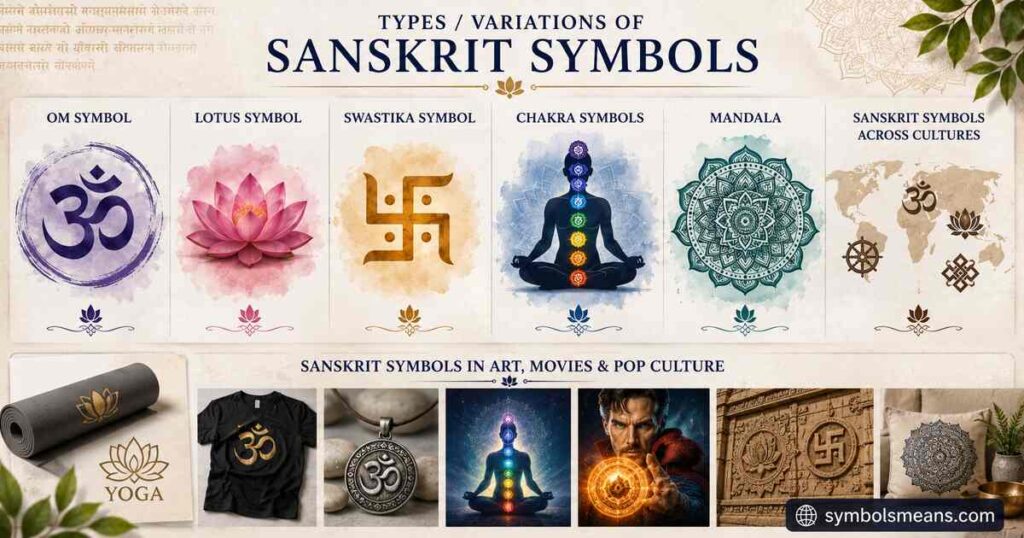
Sanskrit Symbols Across Cultures
Sanskrit symbolism didn’t stay confined to India. As Buddhism spread across Tibet, China, and Southeast Asia, symbols like Om, the lotus, and the mandala were absorbed into new spiritual traditions, often gaining new interpretations along the way. Tibetan Buddhism in particular embraced mandalas as central meditation tools, while the lotus became closely tied to depictions of the Buddha across nearly every Buddhist culture. In the modern West, the global growth of yoga and meditation practices has carried these symbols even further, though often stripped of the deeper religious context they carry in their countries of origin.
Sanskrit Symbols in Art, Movies & Pop Culture
Sanskrit-inspired imagery shows up constantly in global wellness branding, fashion, and film, from lotus logos on yoga studios to Om symbols printed on activewear. In cinema, mandalas and chakra imagery are frequently used to visually represent meditation, transformation, or spiritual awakening. This widespread adoption has helped introduce these symbols to global audiences, though it has also sparked ongoing conversations about respectful use versus surface-level borrowing of sacred imagery.
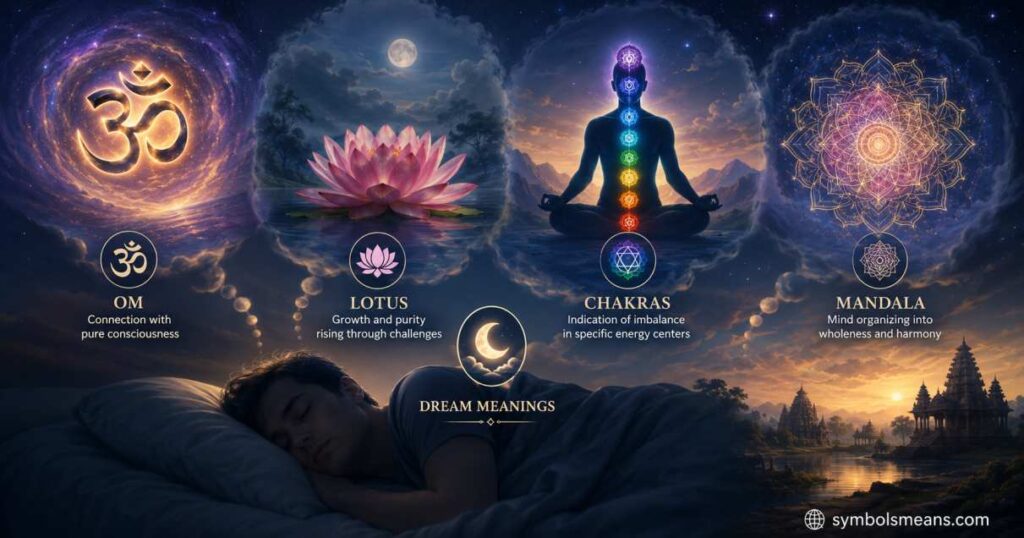
Spiritual & Dream Meaning of Sanskrit Symbols
In dream interpretation influenced by yogic and Hindu tradition, seeing Om is often read as a moment of contact with pure consciousness, an invitation to rest in stillness rather than the mind’s usual noise. A lotus appearing in a dream can signal growth quietly happening beneath the surface, even during a difficult period. Chakra symbols in dreams are sometimes interpreted as pointing to a specific area of imbalance, while a mandala forming in a dream is often read as the mind organizing itself into a more coherent whole.
Positive vs Negative Meaning
Nearly all Sanskrit symbols carry deeply positive, auspicious meaning within their original spiritual context, well-being, growth, unity, and enlightenment. The clearest exception is the swastika, which retains its ancient meaning of good fortune throughout Hindu, Buddhist, and Jain practice, but became globally associated with hatred after its 20th-century appropriation by Nazi Germany. This dual history is worth understanding, since the same shape carries completely opposite meanings depending on cultural and historical context.
Why Humans Are Attracted to This Symbol
People are drawn to Sanskrit symbols because they compress complex spiritual ideas into something simple enough to meditate on, wear, or display. A single Om symbol can represent an entire philosophy about consciousness and unity, while a small lotus can carry a personal story of growth through hardship. In a fast-paced modern world, these ancient, intentional symbols offer something increasingly rare: a visual reminder to slow down and reconnect with something larger than the everyday.
FAQs
What is the most powerful Sanskrit symbol?
Om is widely considered the most powerful and central Sanskrit symbol, representing the sound and vibration of the universe itself.
Are Sanskrit symbols religious?
Many are rooted in Hindu, Buddhist, and Jain tradition, though some, like the lotus, are also used more broadly as general symbols of growth and purity.
Can anyone use Sanskrit symbols?
Yes, though understanding their spiritual and cultural significance before using them, especially in tattoos, is generally seen as a sign of respect.
What do Sanskrit symbols mean in tattoos?
They often represent personal spiritual journeys, such as growth, balance, or enlightenment, depending on the specific symbol chosen.
Are Sanskrit symbols still used today?
Yes, they remain central to Hindu, Buddhist, and yogic practice worldwide and have also become widely recognized in global wellness and spiritual culture.
Conclusion
Sanskrit symbols have survived thousands of years because they capture something words alone can’t fully express, the sound of the universe, the beauty of growth through hardship, and the pursuit of balance and enlightenment. Whether it’s the quiet hum of Om or a lotus rising from the mud, these symbols continue to offer the same thing they always have: a small, powerful reminder of what it means to grow.