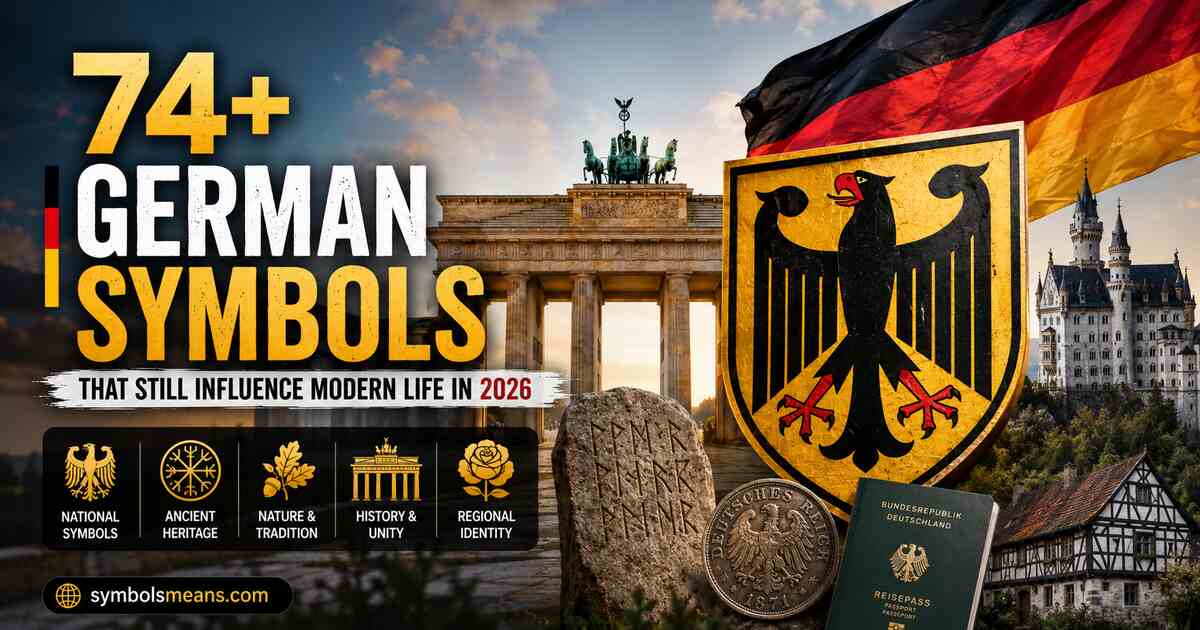
From the black eagle on a passport to ancient runes carved into stone, German symbols carry centuries of history, power, and identity. Some represent unity and democracy. Others carry a far more complicated legacy that modern Germany has spent decades reckoning with. This guide walks through the most important German symbols, what they truly mean, and how their meanings have shifted across history.
What are German Symbols?
German symbols are the images, icons, and emblems that represent the country’s national identity, regional heritage, and historical journey. Some, like the federal eagle, are officially recognized by the state. Others, like ancient runes or the oak tree, come from centuries of folklore and tribal tradition that predate modern Germany entirely.
Together, these symbols tell a layered story, one of empire, division, reunification, and a nation that continues to reflect on its own history through the images it chooses to represent itself.
Ancient German Symbols And Their Hidden Stories
Ancient German Symbols
Long before Germany existed as a unified nation, early Germanic peoples used symbols tied to nature, gods, and tribal identity. These included animal imagery, sun wheels, and early rune-like markings carved into wood and stone.
Germanic Tribe Symbols
Germanic tribes such as the Saxons, Franks, and Goths each carried their own emblems, often animals like wolves, boars, and eagles, chosen to represent strength and the qualities a tribe wanted to be known for in battle.
Germanic Symbols
Beyond tribal emblems, Germanic culture also produced symbolic patterns used in jewelry, weapons, and burial artifacts, many of which historians still study today to understand pre-Christian belief systems in the region.
Read More : 42+ Puerto Rican Symbols That Reveal the Island’s True Soul
German Symbols And Meanings In Modern Culture
German Symbols And Meanings
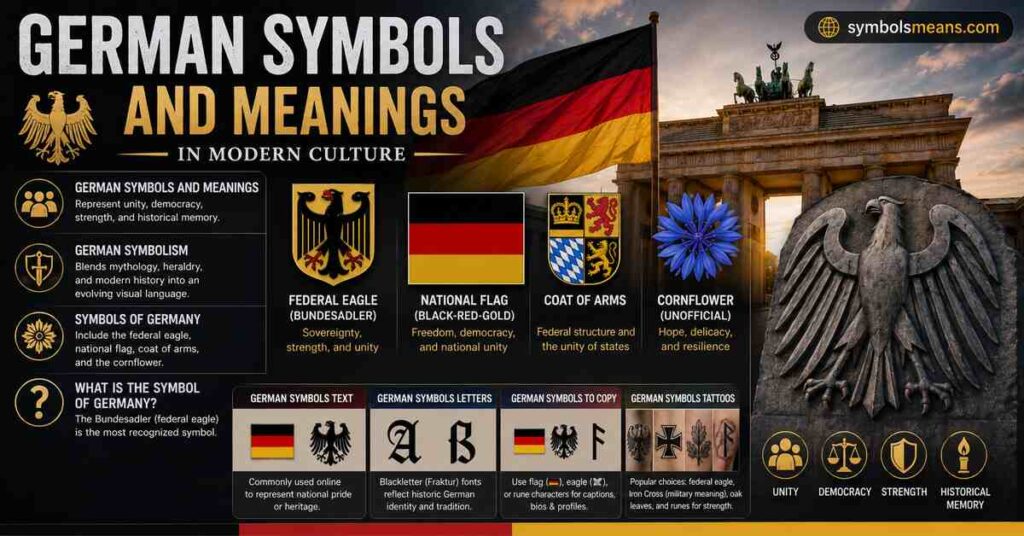
Modern German symbols generally represent one of a few core ideas: unity, democracy, strength, or historical memory. The federal eagle and the black-red-gold flag are the clearest examples of this shift toward democratic identity after the Second World War.
German Symbolism
German symbolism blends mythology, medieval heraldry, and modern political history into a visual language that’s still evolving, particularly as the country continues to process the darker chapters of its 20th-century past.
Symbols Of Germany
Officially, symbols of Germany include the federal eagle, the national flag, the coat of arms, and the cornflower, which serves as the country’s unofficial national flower.
What Is The Symbol Of Germany?
If asked for a single answer, most people point to the Bundesadler, the black federal eagle, as Germany’s most recognized national symbol.
German Symbols Text
Simple text-based versions of German symbols, like the eagle emoji or flag emoji, are commonly used online to represent national pride or heritage in a quick, shareable way.
German Symbols Letters
Historic German typography, including blackletter fonts like Fraktur, is sometimes associated with German identity visually, though its use today is mostly limited to traditional signage and stylized branding.
German Symbols To Copy
For captions and profiles, people often use the flag emoji (🇩🇪), eagle emoji, or simple rune-style characters to reference German heritage in text.
German Symbols Tattoos
Popular tattoo choices include the federal eagle, the Iron Cross (without a swastika, which carries the older military meaning rather than the Nazi-era one), oak leaves, and select runic characters chosen for personal meaning like strength or protection.
Iconic, Ancient And Historical German Symbols
Iconic German Symbols
The federal eagle, the Brandenburg Gate, and the black-red-gold flag are the three most internationally recognized symbols tied to modern Germany.
Traditional German Symbols
Traditional symbols include the oak tree, the cornflower, regional coats of arms, and folk imagery tied to festivals like Oktoberfest.
Famous German Symbols
Globally, Germany is often visually represented by the eagle, its flag, and landmarks like the Brandenburg Gate, which has become a symbol of reunification since the fall of the Berlin Wall.
Ancient German Symbols Tattoos
Tattoo designs drawing from ancient Germanic tradition often include tribal animal imagery or Elder Futhark runes, chosen for personal symbolism like courage or protection rather than any modern political meaning.
Old German Symbols
Older German symbols were shaped heavily by the Holy Roman Empire, where the eagle first became associated with imperial authority across German-speaking lands.
Meaningful German Symbols
The oak tree stands out as one of the most meaningful traditional symbols, representing wisdom, strength, and endurance in German folklore.
German Symbols In War, Politics and Family
WW1 German Symbols
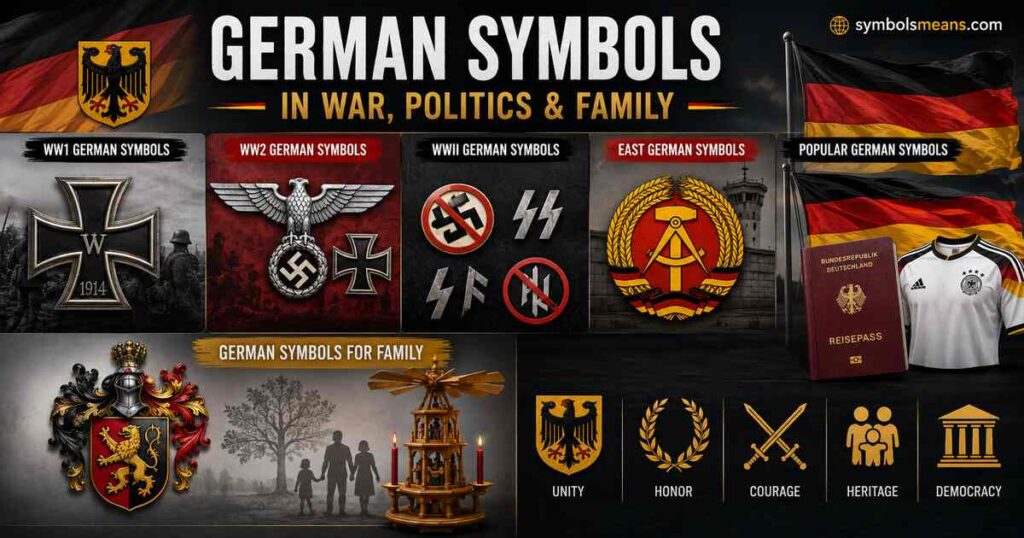
During the First World War, the Iron Cross was the most recognized German military symbol, awarded for bravery and worn broadly across the army as a mark of service.
WW2 German Symbols
During the Second World War, Nazi Germany appropriated older German symbols, including the eagle and the Iron Cross, and combined them with the swastika to represent the Nazi regime. It’s important to understand that this was a deliberate political hijacking of older imagery, not the origin of those symbols themselves.
WWII German Symbols
Because of this history, certain WWII-era symbols, including the swastika and specific rune combinations used by Nazi organizations, are today recognized internationally as hate symbols and remain illegal to display in Germany outside of educational or historical contexts.
East German Symbols
After the war, East Germany rejected the eagle entirely, adopting a hammer and compass surrounded by a ring of wheat as its socialist emblem, representing workers, intellectuals, and farmers.
German Symbols For Family
Traditional German family symbols include the household coat of arms and the Christmas pyramid, both tied to generational continuity and shared heritage.
Popular German Symbols
Today, the flag and the federal eagle remain the most widely used symbols in everyday German life, appearing on passports, government buildings, and national sports jerseys.
Deep Symbolic Meaning of German Symbols
Spiritual Meaning
Spiritually, older Germanic symbols like the eagle were tied to Odin in early tribal belief, representing vision, wisdom, and connection to the divine.
Psychological Meaning
Psychologically, modern German symbols like the flag represent collective memory — a visible reminder of a hard-won democratic identity rebuilt after historical trauma.
Cultural Meaning
Culturally, these symbols reflect Germany’s ongoing relationship with its own history, balancing pride in achievement with deliberate, public acknowledgment of past harm.
Types / Variations of German Symbols
1. Federal Eagle (Bundesadler)
Germany’s national emblem, tracing back to the Holy Roman Empire, representing sovereignty, strength, and democratic continuity in its modern form.
2. Black-Red-Gold Flag
Adopted from 19th-century liberal movements, the flag represents unity, freedom, and democracy, reflecting Germany’s post-war rebuilding and reunification.
3. Iron Cross (Eisernes Kreuz)
Originally a Prussian military honor dating to 1813, the Iron Cross today remains the emblem of Germany’s modern armed forces, distinct from its Nazi-era misuse.
4. Germanic Runes
The Elder Futhark alphabet, used by early Germanic peoples for writing and divination, remains historically and culturally significant, though certain individual runes carry a complicated modern legacy due to their appropriation by Nazi organizations.
5. Holy Roman Empire Eagle
The original imperial eagle, a black eagle on a gold shield, is considered one of the oldest coats of arms still in use in Europe today.
German Symbols Across Cultures
Ancient Germanic Tribes
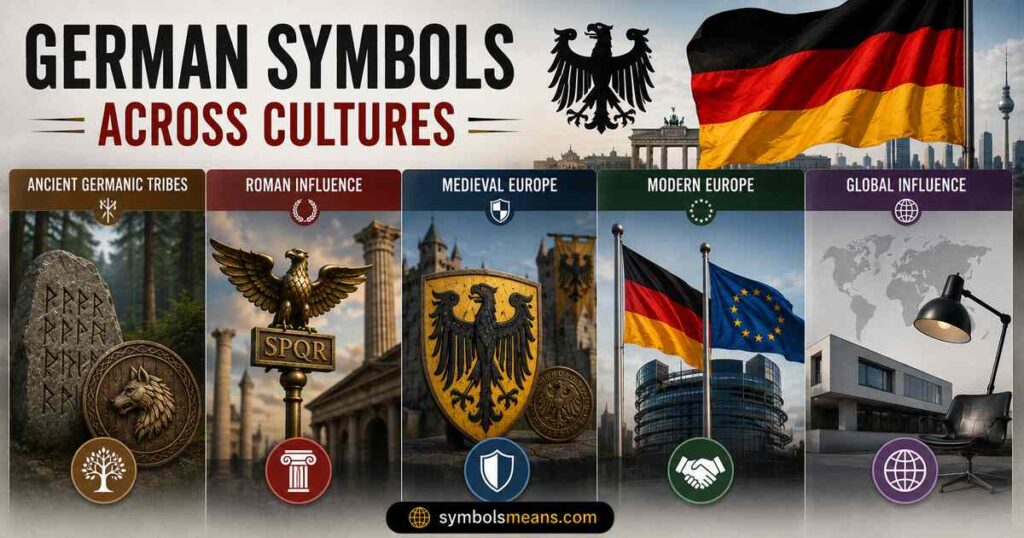
Early tribes used animal totems and rune-like carvings to represent identity, strength, and connection to nature and ancestry.
Roman Influence
The eagle itself was borrowed from Roman military standards, adopted by Germanic rulers to link their authority to the legacy of the Roman Empire.
Medieval Europe
Throughout the medieval period, the eagle became standardized heraldry across the Holy Roman Empire, appearing on shields, banners, and coins.
Modern Europe
Post-war Germany’s symbols, especially the flag and eagle, are now closely tied to the European Union’s broader themes of democracy and cooperation.
Global Influence
German design principles, minimalist and function-driven, have influenced global branding and architecture, extending the country’s symbolic identity beyond its borders.
German Symbols in Art, Movies & Pop Culture
German symbols appear frequently in film and art, often used to represent history, division, or reunification, particularly imagery tied to the Berlin Wall and Brandenburg Gate. In fashion and design, the Bauhaus movement turned German minimalism itself into a globally recognized visual symbol, influencing everything from furniture to typography. Musical symbolism also plays a role, with composers like Beethoven and Bach treated as cultural icons representing German intellectual and artistic achievement.
Spiritual & Dream Meaning of German Symbols
In symbolic and dream interpretation, the eagle often represents clarity, leadership, and rising above difficulty, drawing on its long association with vision and authority. Runic symbols are sometimes interpreted as messages from the subconscious, tied to hidden knowledge or guidance. Cross-like symbols can represent inner conflict or moral decision-making, reflecting the weight these images have carried throughout German history.
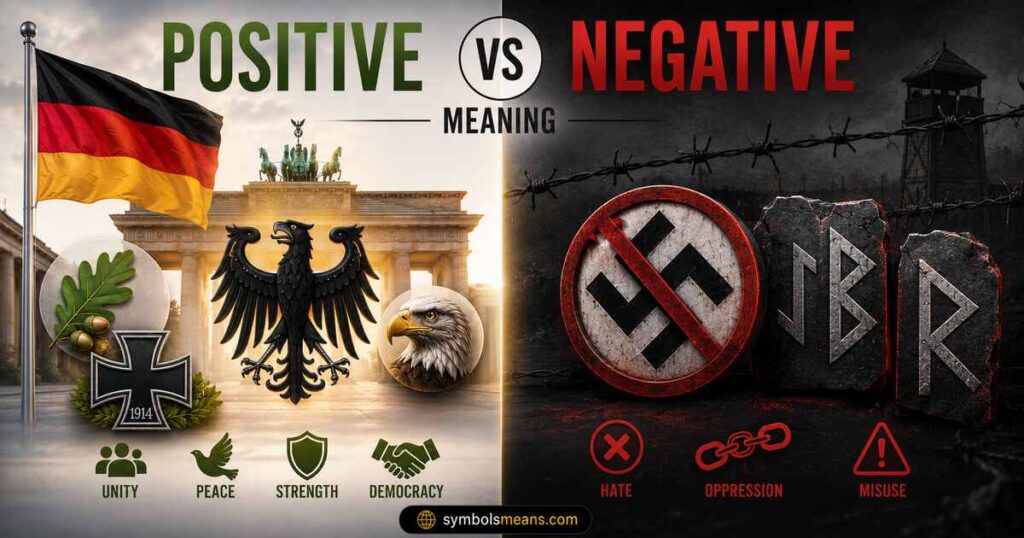
Positive vs Negative Meaning
Positive Meanings
- Unity, democracy, and freedom (flag, federal eagle)
- Strength, wisdom, and endurance (oak tree, eagle)
- Peace and reunification (Brandenburg Gate)
- Bravery and service (Iron Cross, pre-1933 usage)
Negative Interpretations
- Certain WWII-era symbol combinations, including the swastika, remain internationally recognized as hate symbols due to their association with the Holocaust and Nazi ideology
- Some historic runes have been misappropriated by modern extremist groups, which is why context always matters when interpreting them today
- Understanding this history is essential to using or discussing these symbols responsibly
Why Humans Are Attracted to German Symbols
People are drawn to German symbols because they represent an unusually honest national story, one that includes pride in cultural achievement alongside public acknowledgment of historical harm. That combination gives these symbols real weight. A flag or an eagle isn’t just decoration; it represents a country that rebuilt its identity deliberately, choosing symbols of democracy and unity over symbols of the past it wanted to move beyond.
FAQs about German Symbols
What is the most important German symbol today?
The federal eagle (Bundesadler) and the black-red-gold flag are the two most important symbols representing modern Germany.
What do German runes mean?
Ancient runes were used for writing and divination by early Germanic peoples, though some individual runes carry a more complicated modern history due to Nazi-era misuse.
Why is the eagle used in German symbolism?
The eagle traces back to Roman and Holy Roman Empire tradition, historically representing sovereignty, strength, and authority.
Are German symbols religious?
Some ancient symbols were tied to early Germanic spiritual belief, while modern national symbols like the flag are secular.
What does the German flag represent?
The black-red-gold flag represents unity, freedom, and democracy, rooted in 19th-century liberal movements and reaffirmed after WWII.
Are all German symbols ancient?
No, many, like the current flag and coat of arms, are modern designs rooted in 20th-century democratic rebuilding.
Why are German symbols so powerful in design?
Germany’s tradition of minimalist, function-first design has made its symbols feel timeless and adaptable across branding, architecture, and typography worldwide.
Conclusion
German symbols carry one of the most complex stories of any national identity in the world, ancient tribal imagery, imperial heraldry, wartime misuse, and a deliberate, modern rebuilding around democracy and unity. Understanding these symbols means understanding that history honestly, both the achievements worth celebrating and the past Germany continues to acknowledge openly. That honesty is exactly what makes these symbols still so influential today.