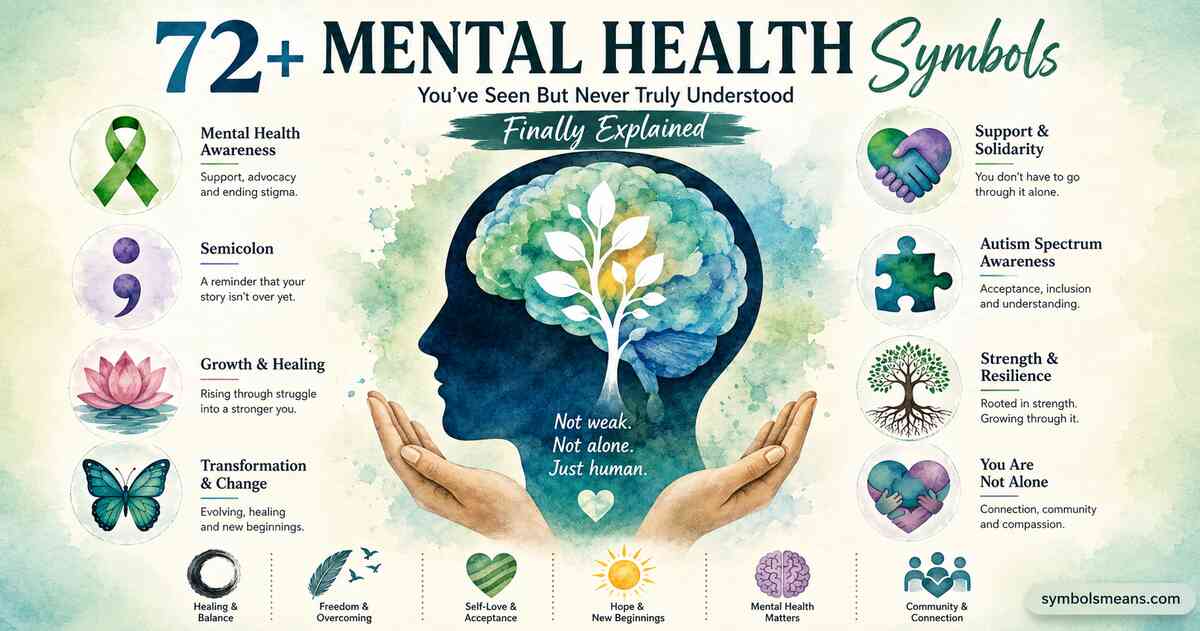
You’ve probably seen a semicolon tattoo, a green ribbon pin, or a lotus flower drawing and sensed it meant something more than decoration. Mental health symbols carry real stories, of survival, recovery, and quiet solidarity between people who understand each other without saying a word. This guide explains what these symbols actually mean, where they came from, and why they matter.
What Are Mental Health Symbols?
Mental health symbols are images, colors, and icons used to represent emotional struggle, awareness, or recovery. They give people a way to express something deeply personal without needing to explain it out loud.
Some are globally recognized, like the green awareness ribbon. Others, like a specific flower or animal, are chosen individually because they reflect someone’s personal journey. Either way, these symbols serve the same purpose: turning an invisible experience into something visible and shareable.
Mental Health Symbols And Meanings
Mental Health Symbols Tattoos
Tattoos are one of the most personal ways people carry these symbols. Because a tattoo is permanent, it becomes a lasting statement: this struggle is part of my story, and I’m not hiding it.
Symbols Of Mental Health Recovery
Recovery-focused symbols emphasize moving forward rather than just surviving. The phoenix, lotus flower, and rising sun are common choices because they represent transformation after hardship rather than the hardship itself.
Mental Health Symbols Copy Paste
For bios, captions, and awareness posts, people often use simple text-based symbols: ♡, ☀, ♾, ;, and 🦋 are common choices, each representing hope, balance, or continuation in a quick, shareable form.
Mental Health Tattoos
Common placements include wrists, forearms, ankles, and behind the ear, visible spots someone can glance at for a quiet reminder during a hard moment.
Mental Health Symbol Emoji
The green heart (💚) has become a widely used emoji shorthand for mental health support online, alongside the butterfly and semicolon, especially in awareness campaigns and social posts.
Mental Health Symbol Drawing
Illustrated versions of these symbols, a lotus rising from water, a butterfly mid-transformation, are popular in journaling, therapy worksheets, and awareness artwork because they visually tell the recovery story in one image.
Read More : 56+ Mysterious Filipino Symbols and Their Hidden Meanings You’ve Never Noticed
Popular Symbols For Mental Health Awareness
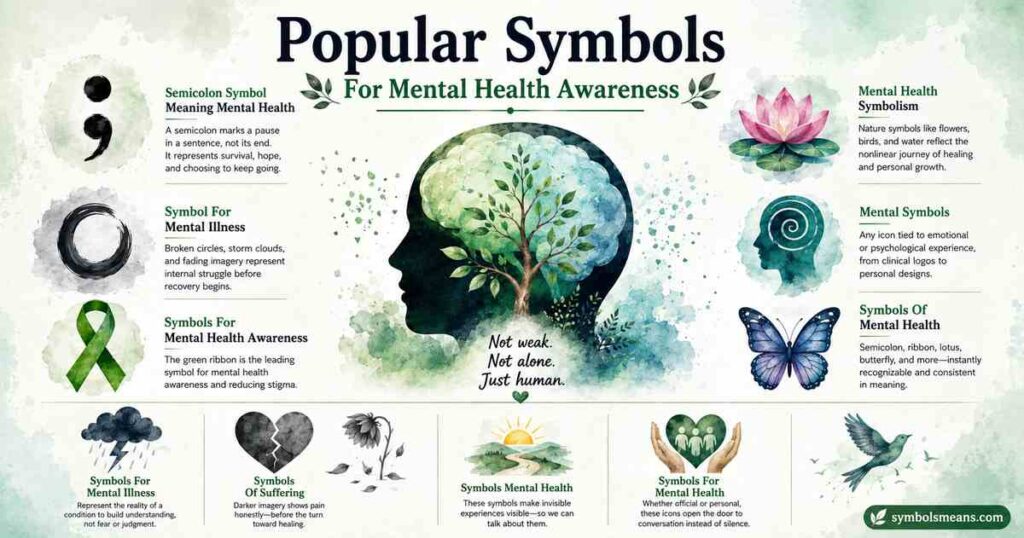
Semicolon Symbol Meaning Mental Health
A semicolon marks a pause in a sentence, not its end. In mental health awareness, it represents a moment when someone’s story could have ended, but didn’t, a message closely tied to suicide prevention and survival.
Symbol For Mental Illness
There’s no single universal symbol for mental illness itself, but broken circles, storm clouds, and fading imagery are often used to represent internal struggle before recovery begins.
Symbols For Mental Health Awareness
The green ribbon leads this category, worn during Mental Health Awareness Month and used across campaigns to visibly show support and reduce stigma.
Mental Health Symbolism
Much of this symbolism draws from nature, flowers, birds, and water, because natural growth cycles mirror the nonlinear process of emotional healing.
Mental Symbols
Broadly, “mental symbols” can refer to any icon tied to emotional or psychological experience, from clinical logos to personal, informal designs.
Symbols Of Mental Health
Across awareness campaigns, the same handful of icons, semicolon, ribbon, lotus, butterfly, repeat because they’re instantly recognizable and carry consistent meaning.
Symbols For Mental Illness
These symbols aim to represent the reality of a condition without minimizing it, often used in educational materials to build understanding rather than fear.
Symbols Of Suffering
Darker imagery — storm clouds, cracked surfaces, wilting flowers, is sometimes used specifically to represent pain honestly, before a recovery symbol shows the turn toward healing.
Symbols Mental Health
Put simply, this entire category exists to make an invisible experience visible enough to talk about.
Symbols For Mental Health
Whether official or personal, these icons share one goal: opening the door to conversation instead of silence.
Mental Health Tattoo And Illustration Meanings
Genogram Mental Health Symbols
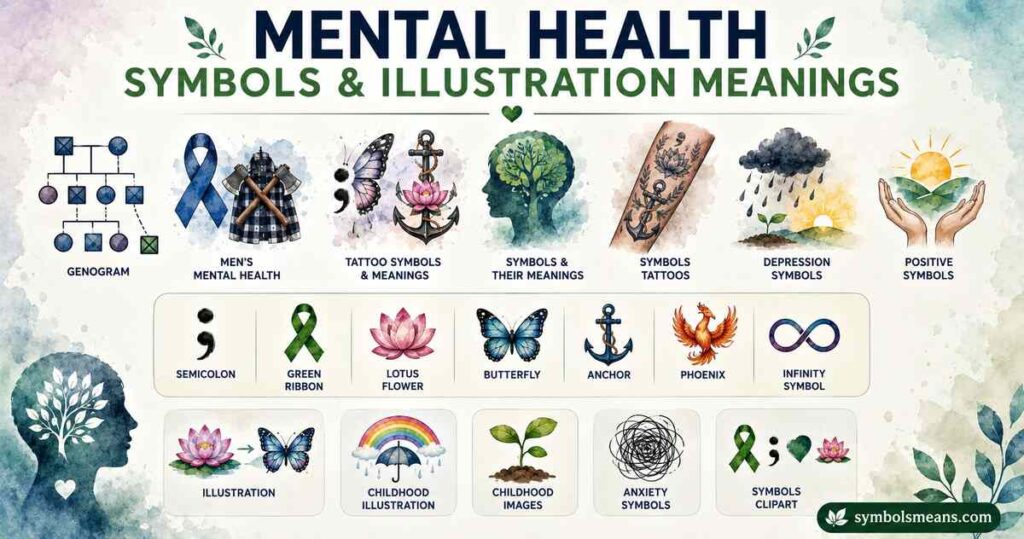
In clinical settings, genograms use standardized shapes and lines to map mental health patterns across family generations, helping therapists visualize inherited patterns of illness or resilience.
Men’s Mental Health Symbols
The blue ribbon and ax-and-flannel imagery have both been used in men’s mental health campaigns, aiming to make emotional openness feel more approachable for male audiences.
Tattoos Mental Health Symbols And Meanings
Popular combinations include a semicolon inside a butterfly wing or a lotus growing from an anchor, blending multiple meanings, survival, transformation, stability, into one design.
Mental Health Symbols And Their Meanings
| Symbol | Core Meaning |
|---|---|
| Semicolon | Continuation, survival, choosing to keep going |
| Green Ribbon | Awareness, hope, ending stigma |
| Lotus Flower | Growth from adversity, purity |
| Butterfly | Transformation, personal change |
| Anchor | Stability, staying grounded |
| Phoenix | Rebirth, resilience after hardship |
| Infinity Symbol | Ongoing journey, endless support |
Mental Health Symbols And Meanings Tattoos
Before getting one of these tattoos, it helps to reflect on what the symbol means to your own experience, not just its general definition online.
Depression Mental Health Symbols
Imagery like storm clouds, fog, or a dimmed sun is sometimes used to represent depression specifically, often paired with a light or dawn symbol nearby to represent hope.
Positive Mental Health Symbols
The rising sun, open hands, and green heart are commonly used to represent stability, encouragement, and emotional support rather than struggle.
Mental Health Symbols Illustration
Illustrated recovery art often layers symbols together, a lotus opening into a butterfly, for example, to visually show progression rather than a single static state.
Childhood Mental Health Symbols Illustration
For children, softer imagery like rainbows, umbrellas in the rain, or a small seedling is often used to explain emotional resilience in an age-appropriate way.
Childhood Mental Health Symbols Images
These images tend to avoid heavier symbolism like the semicolon, focusing instead on growth and safety themes that are easier for young children to understand.
Anxiety Mental Health Symbols
Tangled lines, spirals, or a racing wave are frequently used to visually represent the restless, looping nature of anxious thoughts.
Mental Health Symbols Clipart
Simplified clipart versions of these icons are widely used in classroom materials, workplace wellness campaigns, and printable awareness resources.
Deep Symbolic Meaning
Spiritual Level
On a spiritual level, symbols like the lotus and phoenix suggest that pain isn’t the end of the story — growth and renewal are possible even after the hardest periods.
Psychological Level
Psychologically, these symbols function as cognitive anchors. Seeing or wearing one can trigger a specific, grounding memory of resilience during a difficult moment.
Cultural Level
Culturally, symbols like the green ribbon show how a shared visual can unify an entire movement, turning individual struggles into a collective, visible cause.
Types and Variations of Mental Health Symbols
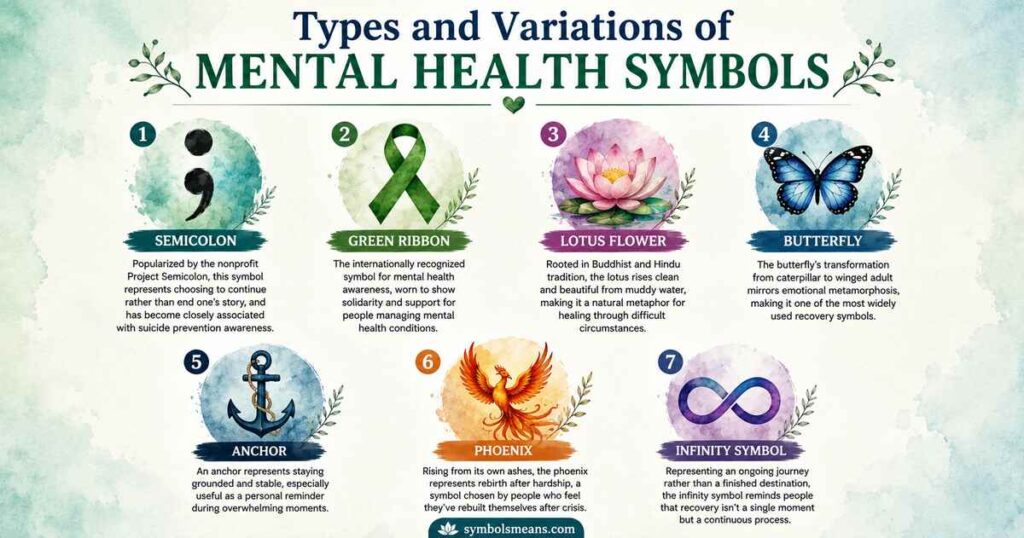
1. Semicolon
Popularized by the nonprofit Project Semicolon, this symbol represents choosing to continue rather than end one’s story, and has become closely associated with suicide prevention awareness.
2. Green Ribbon
The internationally recognized symbol for mental health awareness, worn to show solidarity and support for people managing mental health conditions.
3. Lotus Flower
Rooted in Buddhist and Hindu tradition, the lotus rises clean and beautiful from muddy water, making it a natural metaphor for healing through difficult circumstances.
4. Butterfly
The butterfly’s transformation from caterpillar to winged adult mirrors emotional metamorphosis, making it one of the most widely used recovery symbols.
5. Anchor
An anchor represents staying grounded and stable, especially useful as a personal reminder during overwhelming moments.
6. Phoenix
Rising from its own ashes, the phoenix represents rebirth after hardship, a symbol chosen by people who feel they’ve rebuilt themselves after crisis.
7. Infinity Symbol
Representing an ongoing journey rather than a finished destination, the infinity symbol reminds people that recovery isn’t a single moment but a continuous process.
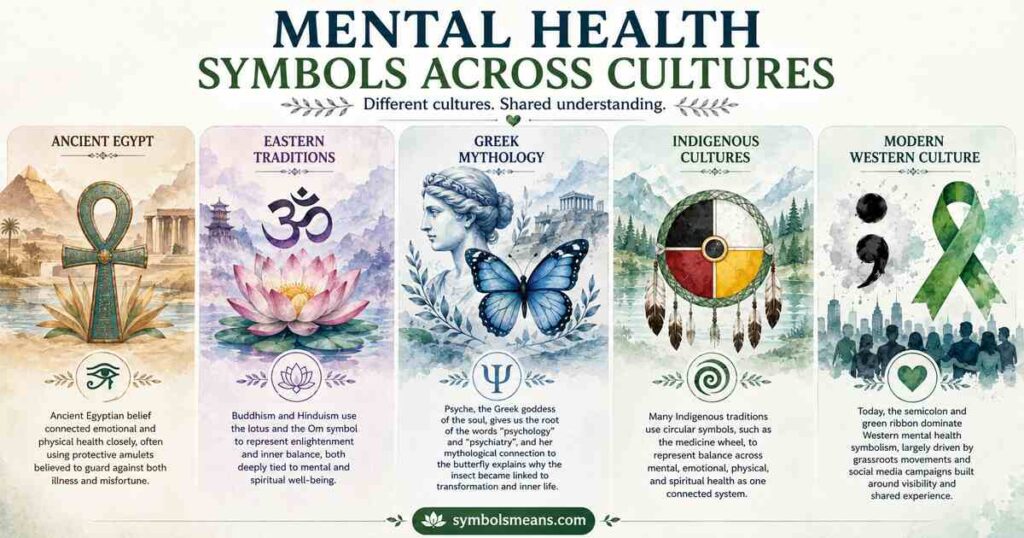
Mental Health Symbols Across Cultures
Ancient Egypt
Ancient Egyptian belief connected emotional and physical health closely, often using protective amulets believed to guard against both illness and misfortune.
Eastern Traditions
Buddhism and Hinduism use the lotus and the Om symbol to represent enlightenment and inner balance, both deeply tied to mental and spiritual well-being.
Greek Mythology
Psyche, the Greek goddess of the soul, gives us the root of the words “psychology” and “psychiatry”, and her mythological connection to the butterfly explains why the insect became linked to transformation and inner life.
Indigenous Cultures
Many Indigenous traditions use circular symbols, such as the medicine wheel, to represent balance across mental, emotional, physical, and spiritual health as one connected system.
Modern Western Culture
Today, the semicolon and green ribbon dominate Western mental health symbolism, largely driven by grassroots movements and social media campaigns built around visibility and shared experience.
Mental Health Symbols in Art, Movies and Pop Culture
Movies
Films frequently use visual metaphors for psychological states, transformation imagery like butterflies, or visual distortion effects to represent conditions like schizophrenia.
Paintings
Edvard Munch’s The Scream remains one of art history’s most recognized visual representations of psychological anguish.
Books
Coming-of-age and recovery narratives often use a recurring object or setting as a quiet symbol for a character’s healing journey.
Tattoos
As covered earlier, tattoo culture has turned mental health symbols into a form of silent recognition between strangers who share similar experiences.
Fashion
Green ribbon pins and semicolon jewelry have moved into mainstream fashion, helping normalize everyday conversations about emotional health.
Spiritual and Dream Meaning of Mental Health Symbols
In dream interpretation, these symbols are often read as messages from the subconscious. A butterfly may suggest transformation is underway, a lotus may signal healing beneath the surface, and an anchor may point to a need for stability. From a Jungian perspective, these are treated as archetypal images the mind uses to process emotional experience.
Positive vs Negative Meaning
Most mental health symbols carry a layered meaning — they acknowledge pain while pointing toward healing. The semicolon recognizes that someone considered a difficult moment before choosing to continue. The phoenix only rises after burning. The lotus only blooms because of the mud beneath it. This duality is intentional: these symbols aren’t meant to erase struggle, but to show that it doesn’t have to be the end of the story.
Why Humans Are Attracted to These Symbols
People are drawn to mental health symbols because they turn something private and hard to explain into something shareable. A small tattoo or pin can say, without a single word, “I understand” or “I’ve been there too.” That instant, silent recognition between people is part of what makes these symbols so powerful, they build community around experiences that often feel isolating.
FAQs
What is the most common mental health symbol?
The semicolon and the green ribbon are the two most widely recognized mental health symbols today.
Why is the green ribbon used for mental health?
Green represents hope, growth, and the ongoing effort to reduce stigma, which is why it became the international color for mental health awareness.
Can mental health symbols help with healing?
Yes, many people find them useful as grounding reminders, though they work best alongside real support like therapy or trusted relationships, not as a replacement for it.
Are mental health symbols universal?
Some, like the green ribbon, are globally recognized, while others carry different meanings depending on culture, religion, or personal experience.
Why do people get mental health tattoos?
Many choose them to mark a milestone in recovery, express solidarity, or carry a permanent, personal reminder of their own resilience.
Conclusion
Mental health symbols exist because some experiences are too heavy to explain in words alone. A semicolon, a green ribbon, or a rising phoenix can say what a sentence sometimes can’t, that struggle happened, and the story is still going. Understanding these symbols isn’t just interesting trivia; it’s a way of recognizing the quiet courage behind them.
This article discusses mental health symbolism, including imagery connected to suicide awareness, in an educational context. If you or someone you know is struggling, please reach out to a mental health professional or a crisis support line in your area.